
Schizophyllan
$1,363.20
- Description
- Additional information
Description
Schizophyllan
Schizophyllan is a fungal-derived, water-soluble beta-Glucan polysaccharide used in pharmaceutical research, biomedical development, drug-delivery studies, formulation research, biotechnology, and other quality-sensitive programs where polymer structure, molecular weight, viscosity, and material consistency are important. It is produced by the filamentous fungus Schizophyllum commune and is characterized by a β-(1→3)-D-Glucan backbone with β-(1→6)-linked Glucose side chains.
• Fungal-derived beta-Glucan polysaccharide
• Produced by Schizophyllum commune
• β-(1→3)-linked Glucan backbone with β-(1→6) Glucose branching
• Nonionic and water soluble
• Suitable for pharmaceutical research, drug-delivery studies, biomaterials, and specialty formulation programs
• Supported by technical documentation for supplier qualification and polymer characterization
Schizophyllan is an extracellular polysaccharide produced by Schizophyllum commune. Its branched beta-Glucan structure gives the polymer distinctive solution, conformational, and biological properties. Published reviews describe Schizophyllan as a nonionic, water-soluble homoglucan containing a β-(1→3)-linked backbone with single β-(1→6)-linked Glucose branches occurring at approximately every third backbone residue.
Because Schizophyllan is a polymeric material, it should not be characterized solely by a single molecular formula or fixed molecular weight. Molecular-weight characteristics can vary according to strain, fermentation conditions, purification, processing, and supplied grade. The U.S. FDA Substance Registration System identifies Schizophyllan under the synonym Sizofiran, CAS Registry Number 9050-67-3, and reports an average molecular weight of approximately 450,000 Da for the registered substance. Other commercial and research materials may have substantially different molecular-weight ranges, making grade-specific characterization important during qualification.
Schizophyllan may be evaluated in pharmaceutical formulation research, biomaterials development, drug-delivery platforms, nucleic-acid delivery studies, immunological research, controlled-release systems, and other biotechnology applications. Recent scientific reviews continue to examine its potential as a functional biomedical polysaccharide, including its use in drug-delivery systems and other advanced pharmaceutical research.
The polymer’s aqueous behavior also makes it relevant to formulation programs where viscosity, stabilization, film formation, or polymer-mediated delivery are important. Its functional characteristics can depend on molecular weight, concentration, branching structure, solution conditions, temperature, and processing history. Research and development teams should therefore evaluate solution viscosity, molecular-weight distribution, solubility, conformation, purity, and compatibility with active ingredients or other formulation components under the intended processing conditions.
For organizations looking to buy Schizophyllan, supplier qualification should extend beyond the general polymer name. A qualified Schizophyllan supplier should provide information regarding microbial source, fermentation and purification controls where applicable, average molecular weight, molecular-weight distribution, viscosity, appearance, moisture content, beta-glucan identity, residual protein, residual processing materials, microbial quality, endotoxin requirements where relevant, and recommended storage conditions. The current specification and Certificate of Analysis should be reviewed before purchase because research, biomedical, cosmetic, and pharmaceutical-development grades may have different acceptance criteria.
CarboMer approaches Schizophyllan sourcing with a regulation-first and manufacturing-centered perspective. Research and development teams benefit from a supplier capable of supporting polymer characterization, solution preparation, rheological evaluation, formulation screening, and scale-up planning. Quality teams require traceable batch documentation and clearly defined material characteristics. Procurement professionals need confidence that the polymer properties established during qualification can be maintained across subsequent purchases and larger program requirements.
When customers purchase Schizophyllan for pharmaceutical or biomedical development, historical or published use should not be interpreted as automatic qualification for a particular dosage form or route of administration. Schizophyllan, also known as Sizofiran, has a history of pharmaceutical investigation and use in some markets, but suitability of a newly sourced material depends on the individual grade, manufacturing controls, purity, microbiological quality, toxicological information, route of administration, and destination-market regulatory requirements.
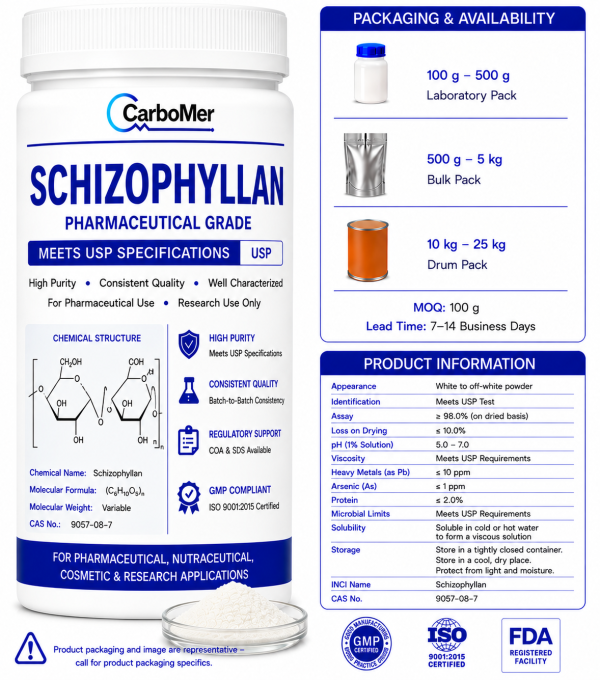
The material is supported by standard technical documentation, including a Certificate of Analysis, Safety Data Sheet, and related product information where applicable. Available characterization may include polymer identity, average molecular weight, molecular-weight distribution, viscosity, moisture, residual protein, microbiological specifications, storage requirements, and retest information. Exact acceptance criteria should be confirmed for the individual grade before ordering.
Schizophyllan should be handled using laboratory or manufacturing controls appropriate to the selected grade and intended application. Powder handling should minimize airborne particulate generation, contamination, and uncontrolled moisture exposure. When preparing aqueous solutions, concentration, mixing rate, hydration time, temperature, and shear conditions should be controlled because these variables can influence polymer viscosity and solution behavior.
The material is packaged in appropriate containers selected to protect product quality from moisture, contamination, and environmental exposure during storage and transportation. Packaging formats, molecular-weight options, minimum order quantities, availability, and lead times may be discussed according to analytical, research, formulation-development, biotechnology, and qualified manufacturing requirements.
As with all CarboMer products, customers receive responsive technical communication and documentation support intended to advance material qualification, polymer characterization, formulation development, scale-up, and long-term supply planning.
Additional information
| Dimensions | 1 × 1 × 1 cm |
|---|