Propylene glycol alginate
$0.00
- Description
- Additional information
Description
Propylene Glycol Alginate
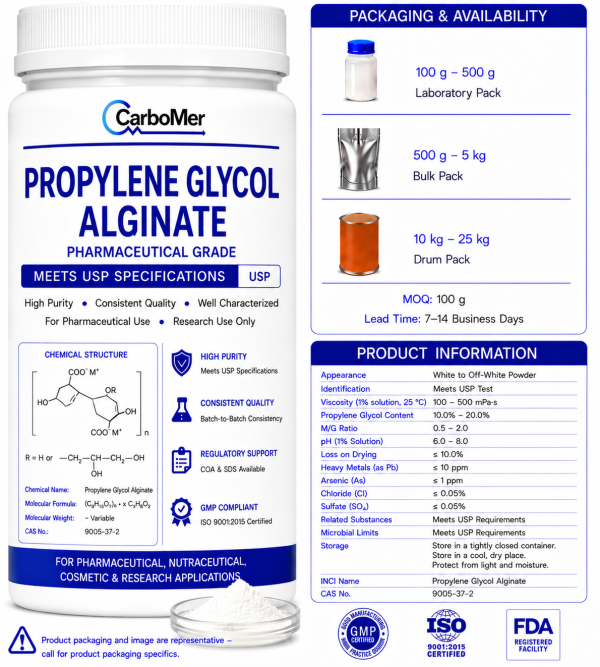
Propylene Glycol Alginate is a chemically modified alginate derivative produced by partial esterification of Alginic acid with Propylene glycol. It is used in food, nutraceutical, pharmaceutical, cosmetic, and specialty formulation programs where stabilization, thickening, emulsification, suspension control, and improved performance under acidic conditions are important.
• Partially esterified derivative of alginic acid
• Functional as a stabilizer, thickener, emulsifier, and viscosity modifier
• Particularly useful in acidic and low-pH formulation environments
• Suitable for food, nutraceutical, pharmaceutical, cosmetic, and specialty applications
• Performance depends on degree of esterification, viscosity grade, molecular characteristics, pH, and processing conditions
• Supported by technical documentation for supplier qualification and material characterization
Propylene Glycol Alginate is derived from alginic acid, a polysaccharide obtained primarily from brown algae. During manufacture, a portion of the carboxyl groups present along the alginate polymer chain is esterified with Ppropylene glycol. This modification changes the behavior of the parent alginate and can improve compatibility with acidic systems while providing useful rheological and interfacial properties.
Unlike unmodified Sodium Alginate, which can readily interact with multivalent ions such as calcium to form gels, Propylene Glycol Alginate is partially esterified and generally exhibits different ionic sensitivity and functional behavior. The degree of esterification is therefore an important quality and performance characteristic. Higher or lower esterification levels can influence viscosity, solubility, emulsification, acid stability, and interaction with proteins or other formulation ingredients.
Propylene Glycol Alginate is widely used in formulations requiring stabilization under acidic conditions. In food and nutraceutical systems, it may be evaluated for beverages, sauces, dressings, emulsified products, flavor systems, and other formulations where suspension, viscosity, and emulsion stability are important. Its ability to function effectively at lower pH can make it particularly useful in applications where conventional alginate systems may provide less predictable performance.
In pharmaceutical and specialty formulation development, Propylene Glycol Alginate may be evaluated as a viscosity modifier, stabilizer, suspending agent, emulsification aid, or matrix-forming polymer. Its suitability depends on the intended dosage form, ingredient interactions, processing method, target viscosity, and regulatory requirements associated with the selected application.
The polymer may also be used in cosmetic and personal-care formulations where controlled viscosity, emulsion stability, texture, and suspension characteristics are required. Performance should be evaluated in the finished formulation because surfactants, salts, proteins, acids, solvents, temperature, and shear can all affect polymer behavior.
For companies looking to buy Propylene Glycol Alginate, supplier qualification should extend beyond general chemical identity. A qualified Propylene Glycol Alginate supplier should provide information regarding alginate source, degree of esterification, viscosity grade, moisture content, pH, particle size, ash, residual processing materials, microbial quality, elemental impurities, and solution characteristics. The grade selected should be matched to the intended formulation because products with different esterification and viscosity characteristics may not perform interchangeably.
CarboMer approaches Propylene Glycol Alginate sourcing with a regulation-first and manufacturing-centered perspective. Research and development teams benefit from a supplier capable of supporting viscosity selection, hydration studies, emulsion evaluation, formulation screening, and scale-up planning. Quality professionals require traceable batch documentation and clearly defined acceptance criteria. Procurement teams need confidence that the polymer characteristics established during qualification can be maintained across repeat purchases and larger production requirements.
When customers purchase Propylene Glycol Alginate for food, pharmaceutical, nutraceutical, or cosmetic applications, the intended function and destination-market requirements should be considered during qualification. Food-use, pharmaceutical-development, research, and specialty grades should not be treated as interchangeable without appropriate review. Application-specific purity, microbiological, elemental impurity, residual solvent, and functional-performance requirements may differ.
The material is supported by standard technical documentation, including a Certificate of Analysis, Safety Data Sheet, and related product information where applicable. Available characterization may include identity, degree of esterification, viscosity, moisture content, pH, ash, particle characteristics, microbial limits, elemental impurities, storage conditions, and retest information. Exact acceptance criteria should be confirmed for the individual grade before ordering.
Propylene Glycol Alginate should be handled using laboratory or manufacturing controls appropriate to the selected grade and intended application. Powder should be protected from contamination and uncontrolled moisture exposure. During solution or dispersion preparation, controlled addition, mixing rate, temperature, pH, hydration time, and polymer concentration should be established to support reproducible viscosity and minimize agglomeration.
The material is packaged in appropriate containers selected to protect product quality from moisture, contamination, and environmental exposure during storage and transportation. Packaging formats, viscosity grades, minimum order quantities, availability, and lead times may be discussed according to food, nutraceutical, pharmaceutical, cosmetic, research, and commercial manufacturing requirements.
As with all CarboMer products, customers receive responsive technical communication and documentation support intended to advance material qualification, formulation development, rheological evaluation, scale-up, and long-term supply planning.
Additional information
| Weight | 0.01 g |
|---|---|
| Dimensions | 1 × 1 × 1 cm |