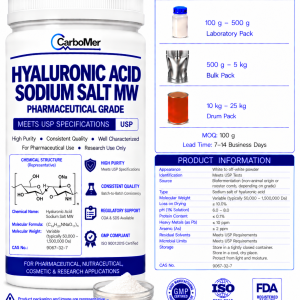
Hyaluronic Acid Sodium Salt MW 5-8 X 10⁴ DA
$459.30
- Description
- Additional information
Description
Hyaluronic Acid Sodium Salt MW | Sodium Hyaluronate
Hyaluronic Acid Sodium Salt, commonly known as Sodium Hyaluronate, is the sodium salt of Hyaluronic acid, a polysaccharide valued for its water-binding and viscoelastic properties. It is used in cosmetic formulation, biomaterials research, and appropriately qualified pharmaceutical and medical applications. MW refers to molecular weight, an important characteristic that influences solution viscosity, hydration behavior, and formulation performance.
For organizations sourcing Sodium Hyaluronate, choosing an appropriate molecular weight range is essential. Contact CarboMer to confirm the molecular weight specification, available grades, and documentation for your intended application.
Sodium Hyaluronate Applications
Skin Care and Personal Care Formulations
Sodium Hyaluronate is used as a humectant and skin-conditioning ingredient in moisturizers, serums, lotions, gels, and masks. Its ability to bind water supports hydration, while its molecular weight and concentration influence texture, film formation, and skin feel.
Different molecular weight grades offer different formulation characteristics. They should not be treated as interchangeable without evaluating their performance in the finished product.
Aqueous Gels and Specialty Formulations
In suitable aqueous systems, Sodium Hyaluronate can contribute viscosity, lubrication, and viscoelastic behavior. These properties depend on molecular weight, concentration, pH, electrolyte content, and interactions with other ingredients.
Formulators may evaluate Sodium Hyaluronate when developing water-based products that require moisture retention and a particular flow or sensory profile.
Biomaterials and Hydrogel Research
Sodium Hyaluronate is studied in hydrogel development, tissue engineering, cell culture systems, and drug delivery research. Depending on the experimental design, it may serve as a polymer matrix or a starting material for further modification.
Unmodified Sodium Hyaluronate does not automatically form a durable, crosslinked hydrogel. Additional chemistry or processing may be required.
Pharmaceutical and Medical Product Development
Appropriately qualified Sodium Hyaluronate grades are used in certain ophthalmic, injectable, and other medical products. These applications require specific controls for identity, purity, molecular weight, microbiological quality, and manufacturing conditions.
Cosmetic or research-grade Sodium Hyaluronate must not be assumed suitable for ophthalmic use, injection, or other clinical applications.
Why Molecular Weight Matters
Sodium Hyaluronate molecular weight describes the size of its polymer chains and is commonly expressed in daltons (Da), kilodaltons (kDa), or megadaltons (MDa).
At comparable concentrations and under similar conditions:
• Higher molecular weight grades generally produce greater viscosity and more pronounced viscoelastic behavior.
• Lower molecular weight grades generally produce less viscous solutions and different formulation characteristics.
• Molecular weight distribution can affect consistency and performance, even when two materials have similar average molecular weights.
Terms such as “low,” “medium,” and “high molecular weight” are not universally standardized. Confirm the numerical range and measurement method rather than relying on these labels alone.
Technical Considerations for Sourcing Sodium Hyaluronate
When evaluating a Hyaluronic Acid Sodium Salt supplier, review:
• Molecular weight specification: Confirm the range, units, and measurement method.
• Material identity and assay: Review specifications for Sodium Hyaluronate content and relevant impurities.
• Source and manufacturing process: Verify fermentation origin or other sourcing details where required.
• Viscosity: Check the test concentration, temperature, and method used to report viscosity.
• Microbiological quality: Evaluate microbial limits, endotoxin, and sterility requirements where applicable. Do not assume these attributes.
• Application suitability: Confirm the documented grade and intended-use designation.
• Preparation and storage: Follow product-specific hydration, handling, and storage instructions to help limit polymer degradation.
• Documentation: Request available specifications, a certificate of analysis, and a safety data sheet.
Source Hyaluronic Acid Sodium Salt from CarboMer
Looking for Sodium Hyaluronate for cosmetic formulation, hydrogel research, or specialty product development? Contact CarboMer with your target molecular weight, intended use, required quantity, and quality requirements to discuss availability and request a quotation.
Because “MW” alone does not identify a molecular weight range, confirm the complete product specification before selecting a material.
Frequently Asked Questions
What is Hyaluronic acid sodium salt?
Hyaluronic Acid Sodium Salt is Sodium Hyaluronate, the Sodium Salt form of Hyaluronic Acid. It is a water-binding polysaccharide used in skin care, research, and appropriately qualified medical products.
What does MW mean in Sodium Hyaluronate?
MW means molecular weight. It describes polymer chain size and helps characterize how the material behaves in solution.
Is Sodium Hyaluronate the same as Hyaluronic acid?
They are closely related but chemically distinct forms. Sodium Hyaluronate is the Sodium Salt of Hyaluronic acid. The names are sometimes used loosely in product marketing, so technical buyers should confirm material identity.
Does higher molecular weight mean better performance?
Not necessarily. The preferred molecular weight depends on the desired viscosity, texture, processing conditions, and intended application.
Can all Sodium Hyaluronate grades be used in injectable or eye-care products?
No. These applications require specifically qualified materials and appropriate manufacturing and regulatory controls. A cosmetic or research designation does not establish clinical suitability.
Additional information
| Weight | 0.01 g |
|---|---|
| Dimensions | 1 × 1 × 1 cm |