
Ethyl propiolate
$974.70
- Description
- Additional information
Description
Ethyl Propiolate
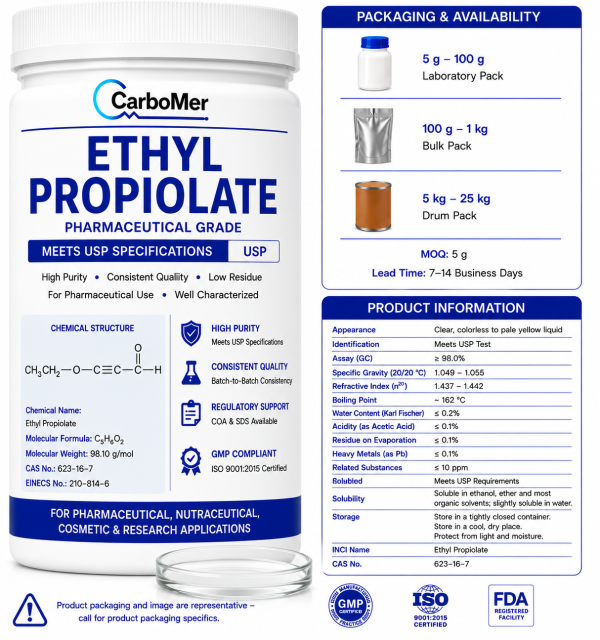
Ethyl Propiolate is a reactive unsaturated ester used as a chemical building block and intermediate in organic synthesis, pharmaceutical development, fine chemical production, and controlled research programs. Also known as Ethyl Prop-2-ynoate, Ethyl Propynoate, and Ethyl Acetylenecarboxylate, it has the molecular formula C₅H₆O₂, a molecular weight of approximately 98.10 g/mol, and CAS Registry Number 623-47-2. Ethyl Propiolate is
• A reactive terminal alkyne ester for organic and medicinal chemistry
• Also identified as Ethyl Prop-2-ynoate and Ethyl Acetylenecarboxylate
• Suitable for research, process development, synthesis, and qualified manufacturing programs
• Supported by technical and safety documentation for supplier qualification and internal review
Ethyl Propiolate is the Ethyl ester of Propiolic acid and contains both an activated carbon-carbon triple bond and an ester functional group. This combination makes it a useful reagent in synthetic chemistry programs where controlled addition, cyclization, coupling, and carbon-carbon bond-forming reactions are required. Its terminal acetylenic structure supports use in the preparation of pharmaceutical intermediates, heterocyclic compounds, specialty chemicals, and other advanced organic molecules.
The material is commonly evaluated by research chemists, process development teams, and specialty chemical manufacturers working on multistep synthetic routes. Depending on the reaction design, Ethyl Propiolate may function as an electrophilic alkyne, an unsaturated ester intermediate, or a starting material for more complex molecular structures. Reaction suitability depends on the purity, water content, stabilizer status where applicable, storage history, and compatibility with the selected catalysts, solvents, and processing conditions.
For organizations looking to buy Ethyl Propiolate, supplier qualification should extend beyond price and immediate availability. A qualified Ethyl Propiolate supplier should provide clear information regarding identity, assay, appearance, water content, related substances, residual solvents, stabilization status where relevant, and storage requirements. The current material specification and Certificate of Analysis should be reviewed before purchase because the chemical name alone does not establish suitability for a specific pharmaceutical, research, or commercial synthesis program.
CarboMer approaches Ethyl Propiolate sourcing with a regulation-first and manufacturing-centered perspective. Research and development teams benefit from a supplier capable of supporting material evaluation, reaction planning, analytical method development, and scale-up. Quality teams require traceable batch documentation and clearly defined acceptance criteria. Procurement professionals need confidence that the selected material can be purchased consistently as demand progresses from laboratory quantities to larger development or manufacturing requirements.
Ethyl Propiolate is identified for laboratory chemical use and the synthesis of substances. Available safety documentation classifies it as a flammable liquid and recommends storage in a cool, dry, well-ventilated location away from heat and ignition sources. One current supplier Safety Data Sheet recommends storage at 2–8 °C, although the conditions stated on the CarboMer product label and supporting documentation should govern the individual material supplied.
Personnel should review the current Safety Data Sheet before receiving, sampling, transferring, or using the material. Appropriate engineering controls, grounded equipment, compatible protective gloves, eye protection, protective clothing, and site-specific procedures should be used based on the assessed risk and scale of operation. Sources of heat, sparks, flames, and static discharge should be controlled during handling.
The material is supported by standard technical documentation, including a Certificate of Analysis, Safety Data Sheet, and related product information where applicable. Available analytical methods, impurity limits, storage conditions, retest periods, transportation classifications, and regulatory support should be confirmed for the individual grade before ordering. Batch-to-batch consistency, traceability, and controlled handling remain central to successful sourcing and downstream synthesis performance.
The material is packaged in compatible containers selected to protect product quality and reduce exposure to moisture, contamination, and ignition risks during storage and transportation. Packaging formats, minimum order quantities, availability, and lead times may be discussed according to research, development, and qualified manufacturing requirements.
As with all CarboMer products, customers receive responsive technical communication and documentation support intended to advance material qualification, synthesis development, scale-up, and long-term supply planning.
Additional information
| Weight | 25 g |
|---|---|
| Dimensions | 1 × 1 × 1 cm |