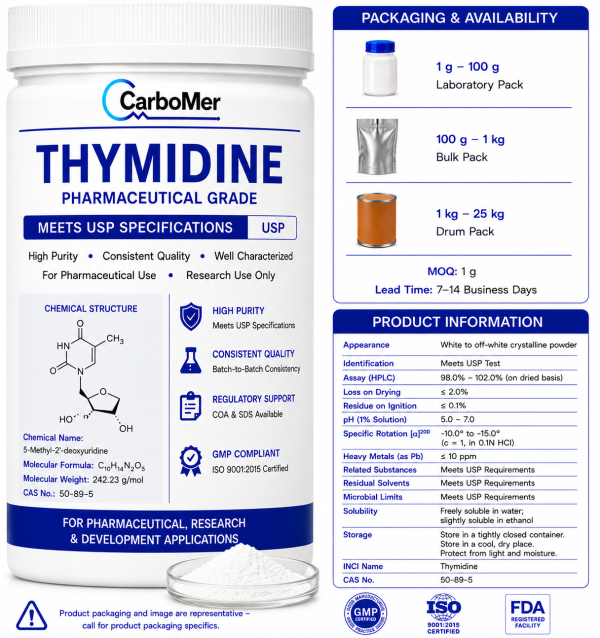

Thymidine
$453.10
- Description
- Additional information
Description
Thymidine
Thymidine is a naturally occurring pyrimidine deoxyribonucleoside used in pharmaceutical research, molecular biology, analytical development, cell-culture studies, nucleoside chemistry, and controlled manufacturing programs. Also known as 2′-Deoxythymidine, it consists of the nucleobase thymine linked to a 2-deoxyribose sugar and serves as a fundamental building block of deoxyribonucleic acid. Thymidine has the molecular formula C₁₀H₁₄N₂O₅, a molecular weight of approximately 242.23 g/mol, and CAS Registry Number 50-89-5. Thymidine is
• Naturally occurring pyrimidine deoxyribonucleoside
• Also identified as 2′-Deoxythymidine, dT, and Thymine Deoxyriboside
• Suitable for molecular biology, analytical, pharmaceutical research, and nucleoside synthesis programs
• Supported by technical documentation for supplier qualification and quality review
Thymidine is a structural component of DNA and participates in the cellular nucleotide salvage pathway. In biological systems, it can be phosphorylated to form thymidine nucleotides that are subsequently incorporated into newly synthesized DNA. These characteristics support its use in research involving DNA replication, cell proliferation, nucleotide metabolism, biochemical assays, and the preparation of nucleoside-related compounds. PubChem classifies Thymidine as a Pyrimidine 2′-deoxyribonucleoside containing thymine as its nucleobase.
The material may be evaluated for cell-culture studies, molecular biology workflows, analytical method development, biochemical research, synthesis of modified nucleosides, pharmaceutical intermediate programs, and controlled laboratory applications. Thymidine has also been used in research protocols designed to synchronize cell populations by temporarily affecting DNA synthesis. Suitability for a specific research, diagnostic, pharmaceutical, or manufacturing application depends on the selected grade, purity, impurity profile, microbial controls, analytical requirements, and intended use.
For organizations looking to buy Thymidine, supplier qualification should extend beyond nominal assay and immediate availability. A qualified Thymidine supplier should provide clear information regarding chemical identity, assay or purity, appearance, water content, related substances, residual solvents, elemental impurities, optical rotation where relevant, microbial requirements, and storage conditions. Customers should review the current material specification and Certificate of Analysis before purchase because research-grade, molecular-biology-grade, analytical, and pharmaceutical-development materials may have different acceptance criteria.
CarboMer approaches Thymidine sourcing with a regulation-first and manufacturing-centered perspective. Research and development teams benefit from a supplier capable of supporting identity review, analytical evaluation, cell-culture suitability assessment, nucleoside synthesis, and scale-up planning. Quality teams require traceable batch documentation and clearly defined specifications. Procurement professionals need confidence that the selected material can be purchased consistently as demand progresses from laboratory quantities to larger development or manufacturing requirements.
When customers purchase Thymidine for biological applications, they may need to evaluate solubility, solution preparation, filtration, microbial quality, endotoxin requirements, and stability under the proposed experimental conditions. PubChem reports that Thymidine is water soluble, although actual dissolution behavior should be confirmed under the concentration, temperature, pH, and buffer conditions used in the individual program.
The material is supported by standard technical documentation, including a Certificate of Analysis, Safety Data Sheet, and related product information where applicable. Available analytical methods, chromatographic purity, water-content limits, residual-solvent controls, storage requirements, retest periods, and regulatory support should be confirmed for the individual grade before ordering. Batch-to-batch consistency, traceability, and controlled handling remain central to reliable nucleoside sourcing and downstream research performance.
Available safety documentation for a commercial Thymidine grade does not classify the material as hazardous under applicable Globally Harmonized System criteria. However, its toxicological properties are not fully characterized, and normal laboratory or manufacturing precautions remain appropriate. Personnel should review the current Safety Data Sheet and follow site-specific procedures when receiving, sampling, weighing, transferring, processing, or disposing of the material.
The material is packaged in appropriate containers selected to protect its quality from contamination, moisture, light, and environmental exposure during storage and transportation. The material is packaged according to the selected grade and order quantity. Packaging formats, minimum order quantities, availability, and lead times may be discussed according to analytical, research, development, and qualified manufacturing requirements.
As with all CarboMer products, customers receive responsive technical communication and documentation support intended to advance material qualification, analytical development, research applications, scale-up, and long-term supply planning.
Additional information
| Dimensions | 1 × 1 × 1 cm |
|---|