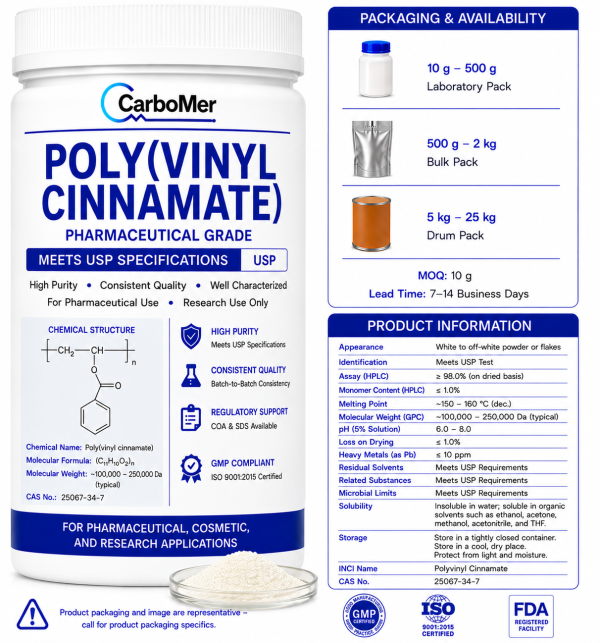

Poly(vinyl cinnamate)
$302.00
- Description
- Additional information
Description
Poly(vinyl Cinnamate)
Poly(vinyl Cinnamate) is a photosensitive polymer used in specialty materials research, photolithography, coatings, optical systems, and other controlled development programs where light-induced crosslinking, film formation, and reproducible polymer performance are important. Its pendant cinnamate groups undergo photochemical reactions under ultraviolet exposure, enabling the material to form crosslinked polymer networks. It
• Is a photosensitive polymer for specialty research and materials applications
• Has pendant cinnamate groups that support ultraviolet-induced crosslinking
• Is suitable for thin-film, photoresist, optical, lithographic, and photopolymer research
• Functional performance can depend on molecular weight, substitution level, film thickness, and irradiation conditions
• Is produced and supplied with attention to polymer consistency and traceability
• Is supported by technical documentation for supplier qualification and material evaluation
Poly(vinyl Cinnamate) is a well-established photo-responsive polymer whose cinnamate side groups can participate in photochemical crosslinking reactions. Research describes both trans-cis photoisomerization and photo-induced crosslinking within Poly(vinyl Cinnamate) films. Photocycloaddition between cinnamate groups can create crosslinks in the polymer matrix, changing film properties after controlled light exposure.
These characteristics make Poly(vinyl Cinnamate) relevant to applications where a polymer film must respond predictably to ultraviolet radiation. Historically, the material has been studied and used as a photosensitive resist, while more recent research has examined its optical behavior, thin-film properties, photopatterning potential, and light-responsive material performance. IUPAC literature describes Poly(vinyl Cinnamate) as a classical resist in which photocycloaddition produces polymer crosslinks.
Depending on the material design and development objective, Poly(vinyl Cinnamate) may be evaluated for photoresist systems, lithographic research, thin-film coatings, optical materials, surface-patterning studies, photonic systems, and other specialty polymer applications. Research also demonstrates that substituted Poly(vinyl Cinnamate) materials can undergo photo-crosslinking through photodimerization of pendant cinnamate groups.
For organizations looking to buy Poly(vinyl Cinnamate) supplier qualification should extend beyond the polymer name and immediate availability. A qualified Poly(vinyl Cinnamate) supplier should provide information regarding polymer identity, molecular-weight characteristics, degree of substitution or cinnamate content where applicable, appearance, residual solvent content, thermal properties, solubility, storage conditions, and other application-specific specifications. Because polymer functionality is strongly influenced by molecular architecture and processing history, customers should review the current material specification before purchase.
CarboMer approaches Poly(vinyl Cinnamate) sourcing with a manufacturing-centered and documentation-focused perspective. Research and development teams benefit from a supplier capable of supporting material characterization, solution preparation, film-development studies, photo-response evaluation, and scale-up planning. Quality professionals require traceable batch documentation and clearly defined acceptance criteria. Procurement teams need confidence that the selected polymer can be purchased consistently as a program progresses from experimental quantities to larger development requirements.
When customers purchase Poly(vinyl Cinnamate) for photosensitive applications, important performance variables may include molecular weight, molecular-weight distribution, degree of cinnamate substitution, solution viscosity, residual monomer or solvent content, film-forming behavior, optical properties, and response to the intended irradiation wavelength and dose. Research on Poly(vinyl Cinnamate) has demonstrated that changes induced by photopolymerization can influence its optical properties, reinforcing the need for application-specific testing rather than relying solely on chemical identity.
The material is supported by standard technical documentation, including a Certificate of Analysis, Safety Data Sheet, and related product information where applicable. Available molecular characterization, residual-solvent limits, thermal data, storage recommendations, retest information, and other polymer-specific specifications should be confirmed for the individual grade before ordering. Batch-to-batch consistency, traceability, and controlled handling remain central to dependable specialty polymer sourcing.
Poly(vinyl Cinnamate) should be handled by trained personnel using appropriate laboratory or manufacturing controls. Because the material is photosensitive, unnecessary exposure to ultraviolet radiation or intense light should be minimized when required by the product specification. Personnel should review the current Safety Data Sheet and follow site-specific procedures for receiving, sampling, weighing, dissolving, coating, processing, storage, and disposal.
The material is packaged in appropriate containers selected to protect polymer quality from contamination, moisture, light, and other environmental conditions that could affect material performance. Packaging formats, minimum order quantities, availability, and lead times may be discussed according to research, materials-development, and qualified manufacturing requirements.
As with all CarboMer products, customers receive responsive technical communication and documentation support intended to advance material qualification, polymer characterization, process development, scale-up, and long-term supply planning.
Additional information
| Weight | 1 g |
|---|---|
| Dimensions | 1 × 1 × 1 cm |