Isomaltose
$2,504.20
- Description
- Additional information
Description
Isomaltose
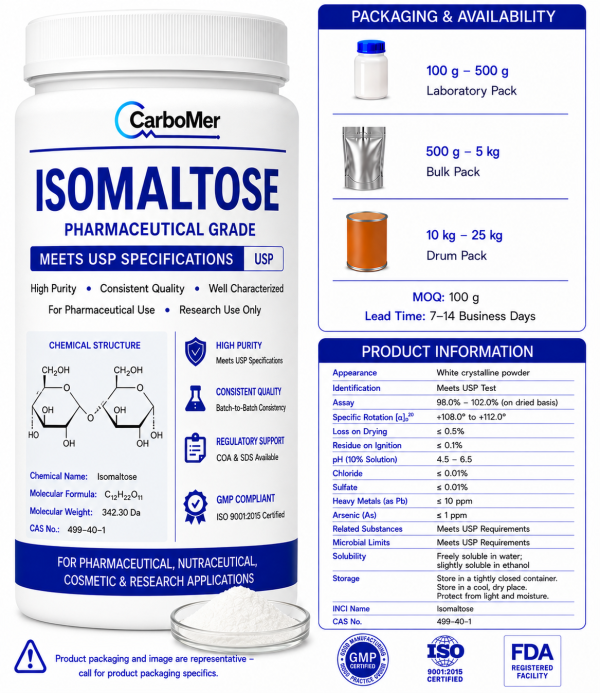
Isomaltose is a reducing disaccharide composed of two D-Glucose units linked through an α-(1→6) glycosidic bond. It is used in carbohydrate chemistry, biochemical research, food analysis, biotechnology, analytical method development, and other controlled research and formulation programs where defined carbohydrate identity, purity, and consistent material performance are important. Isomaltose has the molecular formula C₁₂H₂₂O₁₁, a molecular weight of approximately 342.30 g/mol, and CAS Registry Number 499-40-1.
• Defined Glucose disaccharide containing an α-(1→6) glycosidic linkage
• Molecular formula of C₁₂H₂₂O₁₁
• Molecular weight of approximately 342.30 g/mol
• Suitable for carbohydrate research, biotechnology, analytical, biochemical, and food-science applications
• Available in high-purity and analytical grades depending on program requirements
• Supported by technical documentation for supplier qualification and material evaluation
Isomaltose is structurally distinct from Maltose because its two Glucose residues are joined through an α-(1→6) linkage rather than an α-(1→4) linkage. PubChem defines Isomaltose as a Glycosylglucose consisting of two D-Glucopyranose units connected through this α-(1→6) bond. This linkage influences the compound’s enzymatic recognition, metabolic behavior, and analytical separation from other glucose disaccharides.
The material may be evaluated in carbohydrate metabolism studies, glycosidase and enzyme research, food analysis, fermentation studies, glycan chemistry, biotechnology development, and analytical reference applications. Commercial research materials are available at high purity, including grades specified at approximately 98% by thin-layer chromatography, while dedicated analytical standards are also available for quantitative and qualitative laboratory applications.
Isomaltose is particularly relevant in analytical programs where researchers need to distinguish structurally similar carbohydrates. It may be used during chromatographic or mass-spectrometric method development for the identification and quantification of disaccharides in food, biological, fermentation, or process samples. Research and analytical suppliers also identify applications involving carbohydrate authenticity assessment and biochemical studies.
For organizations looking to buy Isomaltose, supplier qualification should extend beyond nominal purity and immediate availability. A qualified Isomaltose supplier should provide clear information regarding chemical identity, assay or purity, chromatographic profile, appearance, water content, related carbohydrates, residual processing materials, optical characteristics where applicable, microbial quality where required, and recommended storage conditions. Because analytical-standard, biochemical-reagent, research, food-development, and manufacturing grades may have different specifications, customers should confirm the exact grade required before purchase.
CarboMer approaches Isomaltose sourcing with a regulation-first and manufacturing-centered perspective. Research and development teams benefit from a supplier capable of supporting material evaluation, carbohydrate analysis, biochemical studies, and repeat sourcing. Quality professionals require traceable batch information and clearly defined acceptance criteria. Procurement teams need confidence that the material can be purchased consistently as projects progress from laboratory evaluation to larger development or manufacturing quantities.
When customers purchase Isomaltose for biochemical or biotechnology applications, additional characteristics may require evaluation depending on the program. These can include reducing-sugar content, related carbohydrate impurities, solution clarity, water content, microbial limits, and compatibility with enzymes, buffers, fermentation systems, or analytical methods. Isomaltose is hydrolyzed by isomaltase to form two glucose molecules, making enzyme activity and substrate specificity relevant in biochemical programs involving α-Glucosidase or Sucrase-Isomaltase systems.
The material is supported by standard technical documentation, including a Certificate of Analysis, Safety Data Sheet, and related product information where applicable. Available characterization may include identity, assay, chromatographic purity, water content, related carbohydrate profile, storage conditions, and retest information. Exact acceptance criteria should be confirmed for the individual grade before ordering.
Isomaltose should be handled using laboratory or manufacturing controls appropriate to the selected grade and intended application. Personnel should review the current Safety Data Sheet and follow site-specific procedures for receiving, sampling, weighing, dissolving, transferring, processing, storage, and disposal. Containers should be protected from contamination, excess moisture, and environmental conditions that could affect carbohydrate quality.
The material is packaged in appropriate containers selected to protect product integrity during storage, handling, and transportation. Packaging formats, minimum order quantities, availability, and lead times may be discussed according to analytical, research, biotechnology, food-development, and qualified manufacturing requirements.
As with all CarboMer products, customers receive responsive technical communication and documentation support intended to advance material qualification, carbohydrate analysis, research development, scale-up, and long-term supply planning.
Additional information
| Weight | 50 g |
|---|---|
| Dimensions | 1 × 1 × 1 cm |