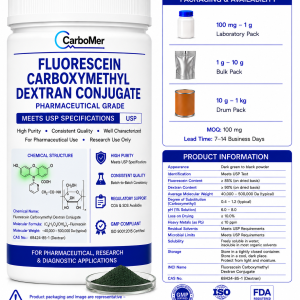
Fluorescein Carboxymethyl Dextran conjugate
- Description
- Additional information
Description
Fluorescein Carboxymethyl Dextran Conjugate
Fluorescein Carboxymethyl Dextran Conjugate is a fluorescently labeled, anionic dextran derivative used in drug-delivery research, permeability studies, biodistribution experiments, imaging applications, analytical development, and other controlled life sciences programs. It is commonly identified as FITC-CM-Dextran or Fluorescein Isothiocyanate–Carboxymethyl–Dextran and combines the water-compatible polysaccharide properties of carboxymethyl dextran with a fluorescein label that enables optical detection.
• Fluorescent conjugate of carboxymethyl dextran
• Also identified as FITC-CM-Dextran
• Anionic fluorescent probe for biological and analytical research
• Available in multiple molecular weight ranges depending on application requirements
• Suitable for permeability, distribution, transport, drug-delivery, and imaging studies
• Supported by technical documentation for supplier qualification and material characterization
Fluorescein Carboxymethyl Dextran Conjugate is produced by attaching a fluorescein-based label to carboxymethylated dextran. The Carboxymethyl groups impart an anionic character to the dextran carrier, while the fluorescent functionality allows researchers to monitor the material using suitable fluorescence-based analytical or imaging methods. Commercial FITC-CM-Dextran materials are available in different average molecular weights, including approximately 4 kDa, 7 kDa, 40 kDa, and 150 kDa, demonstrating the importance of molecular weight as a defining specification for this class of conjugates.
The material may be evaluated in pharmaceutical and life sciences research involving membrane permeability, cellular uptake, tissue distribution, vascular permeability, transport mechanisms, drug-delivery carrier studies, and pharmacokinetic investigations. Published research has used FITC-labeled carboxymethyl dextran materials with different molecular weights and degrees of carboxymethyl substitution to investigate carrier behavior and biodistribution.
The molecular weight is particularly important when selecting a Fluorescein Carboxymethyl Dextran Conjugate. Lower-molecular-weight materials may demonstrate different diffusion, transport, clearance, and tissue-distribution characteristics than higher-molecular-weight conjugates. Researchers should therefore specify the required molecular weight or molecular weight range when purchasing material. The degree of Carboxymethyl substitution and fluorescent labeling density can also influence net charge, optical response, solubility, and biological behavior.
For organizations looking to buy Fluorescein Carboxymethyl Dextran Conjugate, supplier qualification should extend beyond the general conjugate name. A qualified supplier should provide information regarding average molecular weight, molecular weight distribution where available, degree of carboxymethyl substitution, fluorescent labeling level, appearance, solubility, purity, free-fluorophore content, water content, storage conditions, and analytical characterization. Commercial FITC-CM-Dextran grades may specify the extent of labeling as the molar quantity of FITC relative to glucose units, reinforcing the need to qualify the exact grade rather than treating all fluorescent Dextrans as equivalent.
CarboMer approaches Fluorescein Carboxymethyl Dextran Conjugate sourcing with a regulation-first and manufacturing-centered perspective. Research and development teams benefit from a supplier capable of supporting molecular-weight selection, fluorescent characterization, analytical evaluation, transport studies, and repeat sourcing. Quality teams require traceable batch documentation and clearly defined material characteristics. Procurement professionals need confidence that the molecular weight, labeling level, and substitution characteristics qualified during development can be maintained across subsequent purchases.
Fluorescent dextran conjugates require careful analytical control because free dye, metal contamination, labeling variability, or changes in polymer characteristics may influence experimental results. Technical literature on fluorescent Dextrans notes that some FITC-Dextran preparations can produce misleading results in endocytosis studies when free fluorophore or metal contamination is present. Material qualification should therefore include appropriate review of purity and free-dye controls where these parameters are relevant to the intended application.
When customers purchase Fluorescein Carboxymethyl Dextran Conjugate, the current product specification and Certificate of Analysis should be reviewed against the intended research method. Relevant parameters may include molecular weight, degree of substitution, labeling density, fluorescence characteristics, purity, free fluorescein content, solution behavior, microbial quality where required, and storage conditions. Fluorescein-labeled Dextrans typically exhibit excitation and emission characteristics in the approximate 494–521 nm region, although the exact spectral response should be confirmed for the supplied conjugate and experimental environment.
The material is intended primarily for controlled research, analytical, and development programs unless the individual grade has been specifically qualified for another application. Research use of a fluorescent dextran conjugate does not establish suitability for human administration, clinical diagnosis, or commercial pharmaceutical production. Any pharmaceutical or biomedical application requires independent evaluation of manufacturing controls, purity, toxicological information, microbiological quality, intended route of administration, and applicable regulatory requirements.
The material is supported by standard technical documentation, including a Certificate of Analysis, Safety Data Sheet, and related product information where applicable. Available characterization may include molecular weight, degree of substitution, fluorescent labeling level, purity, free-fluorophore limits, solubility, storage requirements, and retest information. Exact acceptance criteria should be confirmed for the individual grade before purchase.
Fluorescein Carboxymethyl Dextran Conjugate should be handled by trained personnel using appropriate laboratory controls. Because fluorescein-based materials are light sensitive, unnecessary exposure to intense light should be minimized. Personnel should review the current Safety Data Sheet and follow site-specific procedures for receiving, sampling, weighing, dissolving, transferring, processing, storage, and disposal.
The material is packaged in appropriate containers selected to protect product quality from light, moisture, contamination, and environmental exposure during storage and transportation. Packaging formats, molecular weight options, minimum order quantities, availability, and lead times may be discussed according to analytical, research, and development purchasing requirements.
As with all CarboMer products, customers receive responsive technical communication and documentation support intended to advance material qualification, analytical development, transport and distribution studies, formulation research, and long-term supply planning.
Additional information
| Dimensions | 1 × 1 × 1 cm |
|---|