Epothilone D
$427.60
- Description
- Additional information
Description
Epothilone D
Epothilone D is a naturally derived macrolide compound belonging to the epothilone class of microtubule-stabilizing agents. It is used primarily in pharmaceutical research, oncology-related studies, neurobiology research, medicinal chemistry, analytical development, and reference-material programs where defined identity, purity, stereochemistry, and controlled handling are important.
• Naturally derived epothilone-class macrolide
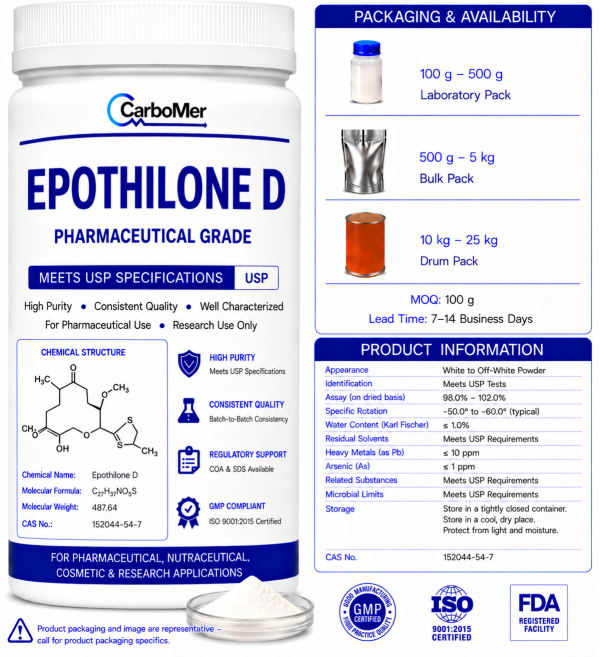
• Molecular formula of C₂₇H₄₁NO₅S
• Molecular weight of approximately 491.68 g/mol
• Investigated as a microtubule-stabilizing compound
• Relevant to oncology, neurobiology, medicinal chemistry, analytical, and mechanism-of-action research
• Supported by technical documentation for supplier qualification and research-use evaluation
Epothilone D is a 16-membered macrolide containing a Thiazole-containing side chain and a defined stereochemical arrangement that is essential to its biological activity. It is structurally related to other members of the epothilone family, including Epothilones A, B, and C. Epothilone D differs from the epoxide-containing Epothilone B through the presence of an olefin in place of the epoxide functionality.
The compound was originally identified among metabolites associated with Sorangium cellulosum, a myxobacterium known for producing epothilone natural products. Epothilones became important research compounds because they stabilize microtubules through mechanisms functionally similar to taxane-class agents while possessing a distinct chemical scaffold.
In pharmaceutical and oncology research, Epothilone D has been investigated for its ability to promote microtubule stabilization and interfere with normal microtubule dynamics. Microtubules play an essential role in mitosis, intracellular transport, structural organization, and other cellular functions. Stabilization of these structures can alter cell division and cellular trafficking, making epothilone compounds useful tools in cancer biology and mechanism-of-action research.
Epothilone D has also been studied in neurobiology because microtubule stability is important to axonal transport and neuronal structure. Research programs have evaluated the compound in models involving abnormal microtubule dynamics and tau-related neurodegenerative processes. These research applications do not establish the material as an approved therapeutic product and should be distinguished from established pharmaceutical use.
For medicinal chemistry programs, Epothilone D can serve as a reference compound, research standard, or starting point for structure-activity relationship studies involving microtubule-stabilizing molecules. Its macrocyclic architecture, stereochemistry, and thiazole-containing side chain make identity confirmation particularly important when evaluating material for synthetic, analytical, or biological studies.
For companies looking to buy Epothilone D, supplier qualification should extend beyond nominal purity. A qualified Epothilone D supplier should provide clear information regarding chemical identity, assay or chromatographic purity, stereochemical identity, related compounds, residual solvents, water content where applicable, analytical characterization, appearance, and recommended storage conditions. Because Epothilone D is structurally similar to other epothilone compounds, analytical differentiation from related substances should form part of material qualification.
CarboMer approaches Epothilone D sourcing with a regulation-first and research-centered perspective. Research and development teams benefit from a supplier capable of supporting identity confirmation, impurity characterization, analytical method development, reference-material evaluation, and specialized research requirements. Quality professionals require traceable batch documentation and clearly defined acceptance criteria. Procurement teams need confidence that the compound supplied corresponds precisely to the material qualified for the research program.
When customers purchase Epothilone D, the intended research use should be clearly defined. The material may be appropriate for in vitro research, analytical studies, medicinal chemistry, biochemical investigations, or other controlled laboratory programs depending on the grade. Research findings involving Epothilone D should not be interpreted as establishing suitability for clinical administration or use in an approved drug product.
The material is supported by standard technical documentation, including a Certificate of Analysis, Safety Data Sheet, and related product information where applicable. Available characterization may include chemical identity, chromatographic purity, stereochemical confirmation, residual solvents, water content, spectroscopic information, storage conditions, and retest information. Exact acceptance criteria should be confirmed for the individual material before ordering.
Epothilone D should be handled by trained personnel using laboratory controls appropriate to a biologically active research compound. Personnel should follow established procedures for receiving, sampling, weighing, transferring, dissolving, processing, storage, decontamination, and disposal. Appropriate containment, personal protective equipment, and occupational exposure controls should be determined through the facility’s hazard assessment and current Safety Data Sheet.
The material is packaged in appropriate containers selected to protect product integrity from moisture, contamination, light, oxidation, and other environmental exposure during storage and transportation. Packaging formats, minimum order quantities, availability, and lead times may be discussed according to analytical, pharmaceutical research, medicinal chemistry, and specialized development requirements.
As with all CarboMer products, customers receive responsive technical communication and documentation support intended to advance material qualification, analytical development, medicinal chemistry, research planning, and long-term supply coordination.
Additional information
| Dimensions | 1 × 1 × 1 cm |
|---|