Deoxyarbutin
$565.90
- Description
- Additional information
Description
Deoxyarbutin
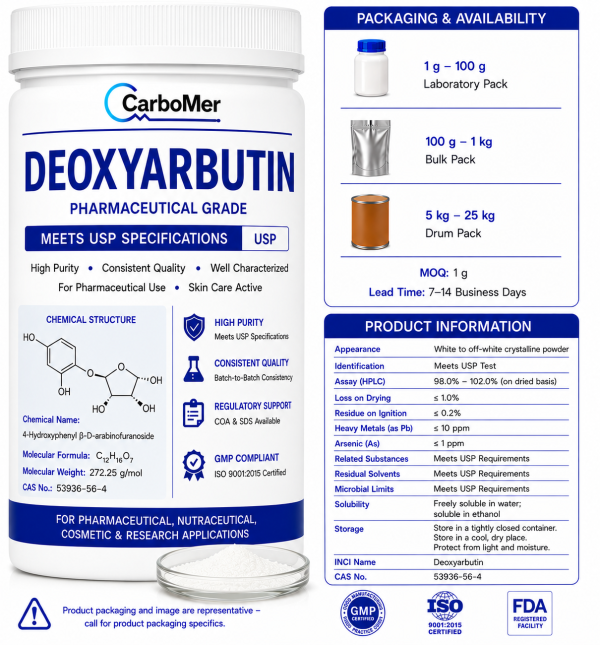
Deoxyarbutin is a synthetic phenolic compound evaluated in cosmetic research, analytical development, and specialized formulation programs involving pigmentation-control and tyrosinase-inhibition studies. It is also known as Tetrahydropyranyloxy Phenol and has the molecular formula C₁₁H₁₄O₃, a molecular weight of approximately 194.23 g/mol, and CAS Registry Number 53936-56-4. Deoxyarbutin is
• Synthetic phenolic compound for cosmetic and analytical research
• Also identified as Tetrahydropyranyloxy Phenol
• Requires careful control of purity, degradation products, moisture, temperature, and formulation conditions
• Supported by technical and safety documentation for supplier qualification and internal review
Deoxyarbutin is structurally related to Arbutin-type compounds and has been studied as a reversible tyrosinase inhibitor. Its intended role in cosmetic research is associated with the control of melanin formation and the development of products designed to influence the appearance of uneven skin pigmentation. The compound should be treated as a specialized development material rather than a broadly interchangeable cosmetic ingredient because its stability, degradation profile, and regulatory acceptability depend heavily on formulation and market conditions.
Formulation teams evaluating Deoxyarbutin should pay particular attention to hydrolytic stability. Published research indicates that water can accelerate its decomposition and that degradation may result in the formation of hydroquinone. Anhydrous polyol-in-silicone systems showed improved stability compared with hydrous emulsions under the conditions examined, although degradation was not eliminated. Formulation pH, temperature, water activity, antioxidants, excipient selection, packaging, and storage conditions may all influence stability.
Deoxyarbutin may be evaluated in anhydrous creams, serums, emulsions, analytical studies, accelerated stability programs, impurity assessments, and other controlled cosmetic-development applications. Suitability for a finished product must be established through product-specific testing that measures Deoxyarbutin retention, hydroquinone formation, appearance, odor, viscosity, pH where applicable, packaging compatibility, and stability throughout the intended shelf life and in-use period.
For organizations looking to buy Deoxyarbutin, supplier qualification should extend beyond nominal purity and immediate availability. A qualified Deoxyarbutin supplier should provide an unambiguous chemical identity, CAS Registry Number, assay or purity value, related-substance profile, hydroquinone limit, water content, residual solvent information, appearance, analytical methods, and recommended storage conditions. Customers should review the current specification and Certificate of Analysis before purchase because the material name alone does not establish suitability for a specific cosmetic formulation or destination market.
CarboMer approaches Deoxyarbutin sourcing with a regulation-first and manufacturing-centered perspective. Research and development teams benefit from a supplier capable of supporting identity confirmation, solubility assessment, compatibility studies, stability-indicating analytical methods, and formulation screening. Quality teams require traceable lot documentation and clearly defined controls for hydroquinone and other degradation products. Procurement professionals need confidence that the selected material can be purchased consistently and stored under conditions that protect its quality.
Regulatory review is essential before Deoxyarbutin is purchased or incorporated into a cosmetic product. The European Commission’s Scientific Committee on Consumer Safety concluded that although Deoxyarbutin itself could be considered safe at concentrations up to 3% in face creams based on the submitted data, the formation of hydroquinone during the product lifecycle raised safety concerns. The committee therefore concluded that its use at up to 3% in face creams was not safe. This conclusion should be considered during market-specific regulatory assessment and product development.
The material is supported by standard technical documentation, including a Certificate of Analysis, Safety Data Sheet, and related product information where applicable. Available analytical methods, impurity controls, hydroquinone limits, residual solvent specifications, storage requirements, retest periods, and regulatory statements should be confirmed for the individual grade before ordering. Batch-to-batch consistency, traceability, and controlled handling remain central to dependable material sourcing.
Deoxyarbutin should be handled by trained personnel using appropriate laboratory or manufacturing controls. Personnel should review the current Safety Data Sheet and follow site-specific procedures for receiving, sampling, weighing, transferring, storage, and disposal. The material should be protected from moisture, excessive heat, light, contamination, and other conditions that may accelerate degradation.
The material is packaged in appropriate containers selected to reduce exposure to moisture, light, oxygen, contamination, and environmental conditions that could affect stability. Packaging formats, minimum order quantities, availability, and lead times may be discussed according to analytical, research, and controlled formulation-development requirements.
As with all CarboMer products, customers receive responsive technical communication and documentation support intended to advance material qualification, formulation evaluation, stability assessment, regulatory review, and long-term supply planning.
Additional information
| Dimensions | 1 × 1 × 1 cm |
|---|