
D-Glucono-d-lactone
$0.00
- Description
- Additional information
Description
Glucono Lactone
Glucono Lactone, commonly known as Glucono Delta-Lactone or GDL, is a cyclic ester of Gluconic acid used in food, pharmaceutical, nutraceutical, cosmetic, analytical, and specialty formulation applications. It is valued for its controlled hydrolysis to gluconic acid in aqueous systems, allowing gradual acidification and predictable pH adjustment during formulation and processing.
• Controlled acidification through gradual hydrolysis to gluconic acid
• Suitable for food, pharmaceutical, nutraceutical, cosmetic, and specialty applications
• Functions as an acidulant, pH modifier, sequestrant, and formulation aid
• Useful where slower acid development is preferred over immediate acid addition
• Water-soluble material with predictable behavior under controlled processing conditions
• Supported by technical documentation for supplier qualification and quality review
Glucono Lactone is the intramolecular ester of gluconic acid formed through cyclization of the molecule. When added to water, it gradually hydrolyzes back to gluconic acid. This controlled conversion is one of the material’s most important functional characteristics because it produces a progressive reduction in pH rather than the immediate acidification associated with direct addition of many conventional acids.
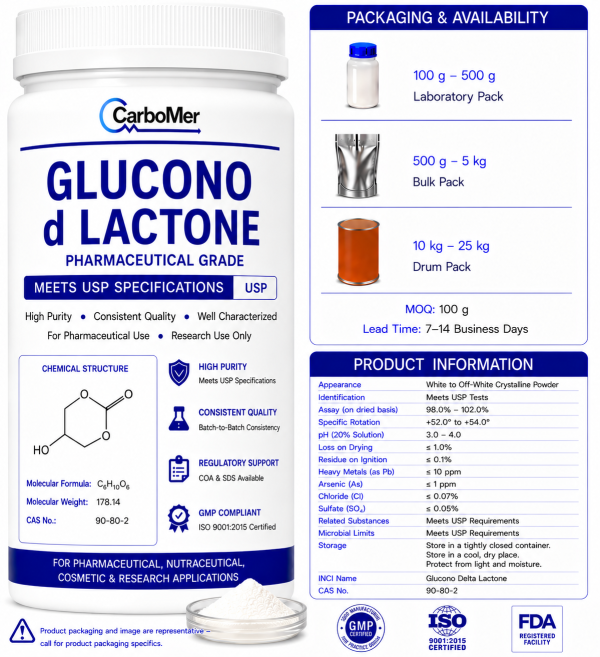
The material has the molecular formula C₆H₁₀O₆ and a molecular weight of approximately 178.14 g/mol. Its chemical behavior makes it useful in systems where controlled acid development can influence texture, gel formation, protein interactions, stability, preservation, or processing consistency.
In food applications, Glucono Lactone is widely used as an acidulant and pH-control ingredient. Its gradual hydrolysis can support controlled coagulation, fermentation-related processing, leavening systems, curing applications, and texture development. It may be evaluated in dairy and dairy-alternative systems, tofu and other protein products, baked goods, processed foods, meat products, beverages, sauces, and other formulations where progressive acidification provides functional advantages.
The slower release of acidity can be especially useful in protein-containing systems. Rapid acidification can create localized pH changes or uneven coagulation, while Glucono Lactone can provide a more gradual and uniform decrease in pH when properly dispersed. Formulators should evaluate concentration, temperature, water activity, mixing conditions, and the buffering capacity of the finished system because these variables influence hydrolysis and final acidification behavior.
In pharmaceutical and nutraceutical development, Glucono Lactone may be evaluated as a pH-adjusting agent, formulation aid, stabilizing component, or intermediate in gluconate-related chemistry. Its water compatibility and conversion to gluconic acid can make it useful where controlled pH modification is preferred. The selected grade should be matched to the intended dosage form, processing method, route of use, and applicable quality requirements.
Glucono Lactone may also be used in cosmetic and personal-care formulations. Its gradual conversion to gluconic acid can support pH adjustment and may be useful in formulations designed around polyhydroxy-acid chemistry. Performance and compatibility should be evaluated in the finished system because surfactants, emulsifiers, preservatives, active ingredients, salts, temperature, and packaging can influence formulation behavior.
For companies looking to buy Glucono Lactone, supplier qualification should extend beyond confirmation of chemical identity. A qualified Glucono Lactone supplier should provide information regarding assay or purity, appearance, water content, acidity, reducing substances where applicable, elemental impurities, residual solvents, microbial quality when required, solution characteristics, and recommended storage conditions.
CarboMer approaches Glucono Lactone sourcing with a regulation-first and manufacturing-centered perspective. Research and development teams benefit from a supplier capable of supporting raw-material evaluation, pH studies, formulation screening, compatibility testing, and scale-up planning. Quality professionals require traceable batch documentation and clearly defined acceptance criteria. Procurement teams need confidence that the material properties established during qualification can be maintained across repeat purchases and larger manufacturing requirements.
When customers purchase Glucono Lactone for food, pharmaceutical, nutraceutical, or cosmetic applications, the selected material grade should be qualified for the intended use and destination market. Food-grade, pharmaceutical-development, analytical, and other specialty materials should not be assumed to be interchangeable without appropriate review. Application-specific purity, microbiological, elemental impurity, and regulatory requirements may differ.
The material is supported by standard technical documentation, including a Certificate of Analysis, Safety Data Sheet, and related product information where applicable. Available characterization may include identity, assay, water content, acidity, impurity controls, elemental impurity information, microbial limits where relevant, storage conditions, and retest information. Exact acceptance criteria should be confirmed for the individual grade before ordering.
Glucono Lactone should be handled using laboratory or manufacturing controls appropriate to the selected grade and application. The material should be protected from contamination and uncontrolled moisture because exposure to water initiates hydrolysis. During formulation, concentration, temperature, mixing conditions, hydration time, initial pH, and buffering capacity should be controlled to support reproducible acidification.
The material is packaged in appropriate containers selected to protect product quality from moisture, contamination, and environmental exposure during storage and transportation. Packaging formats, minimum order quantities, availability, and lead times may be discussed according to food, pharmaceutical, nutraceutical, cosmetic, analytical, research, and commercial manufacturing requirements.
As with all CarboMer products, customers receive responsive technical communication and documentation support intended to advance material qualification, formulation development, pH-control studies, scale-up, and long-term supply planning.
Additional information
| Weight | 5 g |
|---|---|
| Dimensions | 1 × 1 × 1 cm |