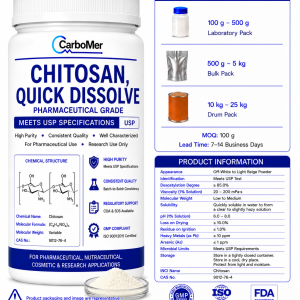
Chitosan, Quick Dissolve
$1,031.80
- Description
- Additional information
Description
Chitosan, Quick Dissolve
Chitosan, Quick Dissolve is a specialized Chitosan grade designed for applications where faster hydration, improved dispersion, and more efficient solution preparation are important. Chitosan is a partially deacetylated derivative of Chitin and is used across pharmaceutical research, biomedical development, nutraceutical, cosmetic, food, water-treatment, and specialty formulation programs where cationic polymer functionality, film formation, binding, and controlled material performance are required.
• Quick-dissolve Chitosan grade for improved hydration and solution preparation
• Derived from partially deacetylated Chitin
• Cationic polysaccharide suitable for pharmaceutical, biomedical, cosmetic, food, and specialty formulation research
• Useful in film-forming, binding, coating, encapsulation, mucoadhesive, and polymer-development applications
• Material performance depends on molecular weight, degree of deacetylation, particle characteristics, pH, and processing conditions
• Supported by technical documentation for supplier qualification and material characterization
Chitosan is a linear polysaccharide composed primarily of glucosamine and N-acetylglucosamine units. It is produced through partial deacetylation of Chitin, a naturally occurring structural polysaccharide commonly obtained from crustacean shells or other suitable biological sources. The resulting polymer contains primary amino groups that give Chitosan its characteristic cationic behavior under acidic conditions.
Chitosan, Quick Dissolve is intended for programs where dissolution and hydration efficiency are important processing considerations. Conventional Chitosan typically has limited solubility in neutral water and is commonly dissolved using dilute acidic media. A quick-dissolve grade may be processed or selected to improve wetting, dispersion, hydration, or dissolution characteristics compared with standard grades. The exact mechanism and performance characteristics should be confirmed against the individual CarboMer product specification rather than assumed solely from the Quick Dissolve designation.
The material may be evaluated for pharmaceutical formulation research, oral and mucosal drug-delivery systems, films, coatings, hydrogels, nanoparticles, encapsulation platforms, biomedical materials, cosmetic formulations, food-related research, and specialty industrial systems. Chitosan is also commonly investigated as a mucoadhesive polymer because protonation of its amino groups under appropriate conditions creates a positive charge that can interact with negatively charged biological surfaces and other formulation components.
For companies looking to buy Chitosan, Quick Dissolve, supplier qualification should include more than confirmation of the general polymer identity. A qualified Chitosan, Quick Dissolve supplier should provide information regarding raw-material source, degree of deacetylation, molecular weight or molecular-weight range, viscosity, particle size, moisture content, ash, protein residues, microbial quality, elemental impurities, residual processing materials, and dissolution or dispersion characteristics. Customers should also determine the acid concentration, pH, temperature, mixing conditions, and hydration time used to characterize quick-dissolve performance.
CarboMer approaches Chitosan, Quick Dissolve sourcing with a regulation-first and manufacturing-centered perspective. Research and development teams benefit from a supplier capable of supporting polymer characterization, dissolution studies, rheological evaluation, formulation screening, and scale-up planning. Quality professionals require traceable batch documentation and clearly defined acceptance criteria. Procurement teams need confidence that the polymer characteristics established during qualification can be maintained across repeat purchases and larger production requirements.
When customers purchase Chitosan, Quick Dissolve for pharmaceutical or biomedical development, the intended route of use should be considered during material qualification. Research demonstrating Chitosan’s use in drug delivery, wound-related materials, films, nanoparticles, or other biomedical systems does not automatically establish that every commercially available grade is suitable for human administration. Source, purity, manufacturing controls, microbial specifications, endotoxin requirements where applicable, toxicological information, and application-specific regulatory requirements should be reviewed for the selected grade.
The material is supported by standard technical documentation, including a Certificate of Analysis, Safety Data Sheet, and related product information where applicable. Available characterization may include identity, degree of deacetylation, viscosity, molecular-weight information, moisture content, ash, particle size, microbial limits, dissolution characteristics, storage conditions, and retest information. Exact acceptance criteria should be confirmed for the individual grade before ordering.
Chitosan, Quick Dissolve should be handled using laboratory or manufacturing controls appropriate to the selected grade and application. Powder should be protected from contamination and uncontrolled moisture exposure. During solution preparation, controlled powder addition, acid concentration, pH, mixing rate, temperature, and hydration time should be established to support reproducible dissolution and viscosity.
The material is packaged in appropriate containers selected to protect product quality from moisture, contamination, and environmental exposure during storage and transportation. Packaging formats, viscosity or molecular-weight options where available, minimum order quantities, availability, and lead times may be discussed according to pharmaceutical, biomedical, cosmetic, food, research, and qualified manufacturing requirements.
As with all CarboMer products, customers receive responsive technical communication and documentation support intended to advance material qualification, polymer characterization, formulation development, scale-up, and long-term supply planning.
Additional information
| Dimensions | 1 × 1 × 1 cm |
|---|