Chitosan Linoleic Acid
$884.40
- Description
- Additional information
Description
Chitosan Linoleic Acid
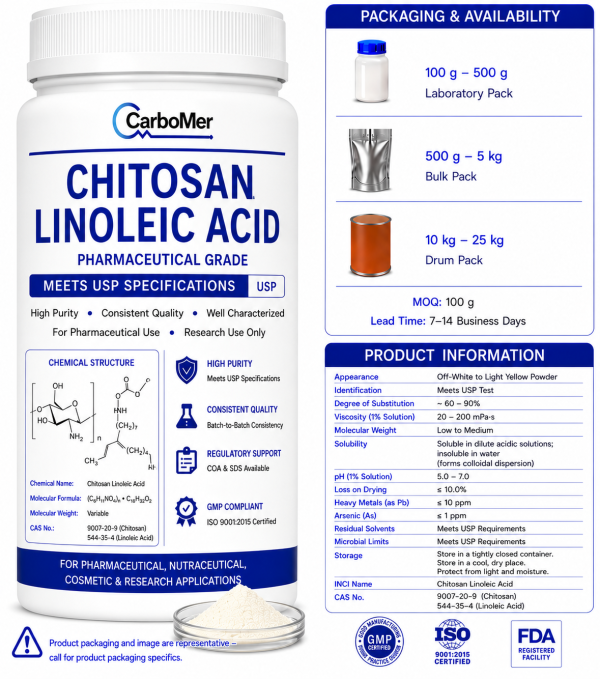
Chitosan Linoleic acid is an amphiphilic Chitosan derivative produced through association or conjugation of Chitosan with Linoleic acid. It is used in pharmaceutical research, drug-delivery development, biomaterials, topical formulation research, nanoparticle systems, and other quality-sensitive programs where the combination of a hydrophilic polysaccharide backbone and hydrophobic fatty-acid functionality can support self-assembly, encapsulation, and controlled material interactions.
• Amphiphilic derivative combining Chitosan and Linoleic acid
• Suitable for nanoparticle, micelle, hydrogel, coating, and drug-delivery research
• Hydrophobic Linoleic acid modification can promote self-assembly in aqueous systems
• Functional behavior depends on Chitosan molecular weight, degree of deacetylation, Linoleic acid substitution, and manufacturing method
• Applicable to pharmaceutical, biomedical, topical, and specialty formulation development
• Supported by technical documentation for supplier qualification and polymer characterization
Chitosan Linoleic acid combines the cationic polysaccharide characteristics of Chitosan with the hydrophobic properties of Linoleic acid, a polyunsaturated fatty acid. Depending on the manufacturing process, Linoleic acid may be covalently grafted to the Chitosan backbone or associated through ionic interactions. These different approaches can produce materials with substantially different physicochemical characteristics, making the exact chemical structure and method of preparation important components of product qualification.
Covalently modified Chitosan Linoleic acid materials have been investigated as amphiphilic polymers capable of forming self-assembled nanoparticles or micellar structures in aqueous environments. Linoleic acid provides hydrophobic domains capable of interacting with poorly water-soluble compounds, while the Chitosan component contributes hydrophilic and cationic characteristics. Research on Linoleic acid-modified Chitosan systems has demonstrated that substitution level can influence particle formation, encapsulation behavior, aqueous dispersion, and release characteristics.
Chitosan Linoleic acid may be evaluated in drug-delivery research involving poorly soluble active compounds, nanoparticle development, encapsulation systems, gene-delivery research, topical delivery, hydrogels, and biomaterial coatings. Linoleic acid-modified Chitosan has also been studied in nanoparticle systems designed to combine polymeric carrier properties with fatty-acid-mediated hydrophobic interactions. Other research has evaluated Chitosan and Linoleic acid combinations for topical carrier systems and wound-related biomaterial applications.
For companies looking to buy Chitosan Linoleic acid, supplier qualification should extend beyond the general material name. A qualified Chitosan Linoleic acid supplier should provide information regarding Chitosan source, molecular weight, degree of deacetylation, Linoleic acid content, degree of substitution or grafting, bonding or association method, appearance, residual solvents, residual reagents, water content, particle or aggregation characteristics where applicable, and recommended storage conditions. Customers should confirm whether the material is a covalent conjugate, ionic complex, physical association, or another modified Chitosan system before purchase.
CarboMer approaches Chitosan Linoleic acid sourcing with a regulation-first and manufacturing-centered perspective. Research and development teams benefit from a supplier capable of supporting polymer characterization, self-assembly studies, nanoparticle development, encapsulation evaluation, formulation screening, and scale-up planning. Quality professionals require traceable batch documentation and clearly defined substitution and purity characteristics. Procurement teams need confidence that the material properties established during qualification can be maintained across repeat purchases.
When customers purchase Chitosan Linoleic acid for pharmaceutical or biomedical development, the intended application and route of use should be evaluated independently. Research demonstrating the performance of a specific Chitosan-Linoleic acid conjugate does not establish that every material sold under this name has equivalent properties or is suitable for human administration. Manufacturing controls, residual reagents, polymer characteristics, microbial quality, toxicological information, and application-specific regulatory requirements must be evaluated for the individual grade.
The material is supported by standard technical documentation, including a Certificate of Analysis, Safety Data Sheet, and related product information where applicable. Available characterization may include Chitosan identity, molecular weight, degree of deacetylation, Linoleic acid content, degree of substitution, residual solvent information, moisture content, solubility or dispersion characteristics, storage conditions, and retest information. Exact acceptance criteria should be confirmed for the individual grade before ordering.
Chitosan Linoleic acid should be handled using laboratory or manufacturing controls appropriate to the selected grade and intended application. Powder or dried material should be protected from contamination, uncontrolled moisture exposure, excessive heat, and oxidative conditions that could affect the Linoleic acid component. During solution or dispersion preparation, pH, ionic strength, polymer concentration, temperature, mixing conditions, and processing sequence should be controlled because these variables may influence aggregation and formulation performance.
The material is packaged in appropriate containers selected to protect product quality from moisture, oxygen, light, contamination, and environmental exposure during storage and transportation. Packaging formats, molecular-weight or substitution options where available, minimum order quantities, availability, and lead times may be discussed according to analytical, pharmaceutical research, biomedical, formulation-development, and qualified manufacturing requirements.
As with all CarboMer products, customers receive responsive technical communication and documentation support intended to advance material qualification, polymer characterization, formulation development, scale-up, and long-term supply planning.
Additional information
| Weight | 5 g |
|---|---|
| Dimensions | 1 × 1 × 1 cm |