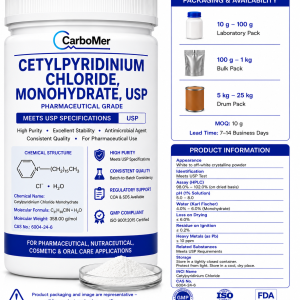
Cetylpyridinium Chloride, Monohydrate, USP
$455.90
- Description
- Additional information
Description
Cetylpyridinium Chloride, Monohydrate, USP
Cetylpyridinium Chloride, Monohydrate, USP is a pharmaceutical-grade quaternary ammonium compound used in regulated oral care, topical, and specialty formulation programs where compendial alignment, antimicrobial functionality, material consistency, and dependable sourcing are essential. The monohydrate has the molecular formula C₂₁H₃₈ClN·H₂O and a molecular weight of approximately 358.00 g/mol. It is
• A USP-grade Cetylpyridinium chloride monohydrate
• A quaternary ammonium compound with surfactant and antimicrobial functionality
• Suitable for oral rinses, mouthwashes, lozenges, and other qualified topical applications
• Freely soluble in water and compatible with suitable aqueous formulation systems
• Produced with attention to batch-to-batch consistency, traceability, and controlled quality practices
• Supported by technical documentation for supplier qualification and regulatory review
Cetylpyridinium Chloride, Monohydrate, USP is used in pharmaceutical and oral care development programs where cationic surfactant properties and controlled antimicrobial performance are required. Cetylpyridinium chloride is the chloride salt of a quaternary ammonium compound and is used in products such as oral rinses and lozenges. Its positively charged structure interacts with negatively charged microbial cell surfaces, which supports its use in qualified antimicrobial and oral hygiene applications.
The material may be evaluated for mouthwashes, oral rinses, throat lozenges, topical preparations, and specialty hygiene formulations. Current United States over-the-counter labeling includes Cetylpyridinium chloride as an active ingredient in antiplaque and antigingivitis mouthwash products. The selected concentration, dosage form, excipient system, labeling, and regulatory pathway must be established according to the intended application and destination market.
Formulation teams should consider the material’s cationic character when evaluating compatibility with anionic surfactants, polymers, flavors, preservatives, colorants, and other formulation components. Solution pH, ionic strength, processing temperature, order of addition, mixing conditions, and packaging compatibility may influence finished-product performance. Development studies should confirm assay recovery, physical stability, antimicrobial effectiveness, appearance, and compatibility throughout the proposed shelf life.
For companies looking to buy Cetylpyridinium Chloride, Monohydrate, USP, supplier qualification should extend beyond immediate price and availability. A qualified supplier should provide clear information regarding identity, assay, water content, related substances, appearance, solution characteristics, residual solvents, elemental impurities, and microbiological requirements where applicable. The current United States Pharmacopeia monograph specifies that Cetylpyridinium Chloride contains not less than 98.0% and not more than 102.0% of cetylpyridinium chloride, calculated on the anhydrous basis.
CarboMer approaches Cetylpyridinium Chloride, Monohydrate, USP sourcing with a regulation-first and manufacturing-centered perspective. Research and development teams benefit from a supplier that can support formulation evaluation, compatibility testing, analytical method development, and scale-up planning. Quality and regulatory teams require traceable batch records, specification clarity, and documentation suitable for internal qualification. Procurement teams need confidence that the material can be purchased consistently as programs progress from development quantities to commercial demand.
When customers purchase Cetylpyridinium Chloride, Monohydrate, USP, they should review the current specification and Certificate of Analysis against the intended dosage form and regulatory requirements. The USP designation should not be treated as the only measure of suitability. Customers should also evaluate impurity controls, physical characteristics, microbiological requirements, packaging configuration, storage conditions, and any application-specific performance criteria.
The material is supported by standard technical documentation, including a Certificate of Analysis, Safety Data Sheet, and related product information where applicable. Available analytical methods, impurity limits, residual solvent controls, elemental impurity information, storage requirements, and retest periods should be confirmed for the individual grade before purchase. Batch-to-batch consistency, traceability, and controlled handling remain central to reliable pharmaceutical and oral care ingredient sourcing.
Personnel should review the current Safety Data Sheet and follow appropriate site-specific procedures when receiving, sampling, weighing, transferring, or processing the material. Suitable personal protective equipment, engineering controls, and good industrial hygiene practices should be used according to the assessed risks and scale of operation.
The material is packaged in appropriate containers selected to protect product quality from moisture, contamination, and environmental exposure during storage, handling, and transportation. Packaging formats, minimum order quantities, availability, and lead times may be discussed according to development scale and commercial purchasing requirements.
As with all CarboMer products, customers receive responsive technical communication and documentation support intended to advance material qualification, formulation development, scale-up, and long-term supply planning.
Additional information
| Dimensions | 1 × 1 × 1 cm |
|---|