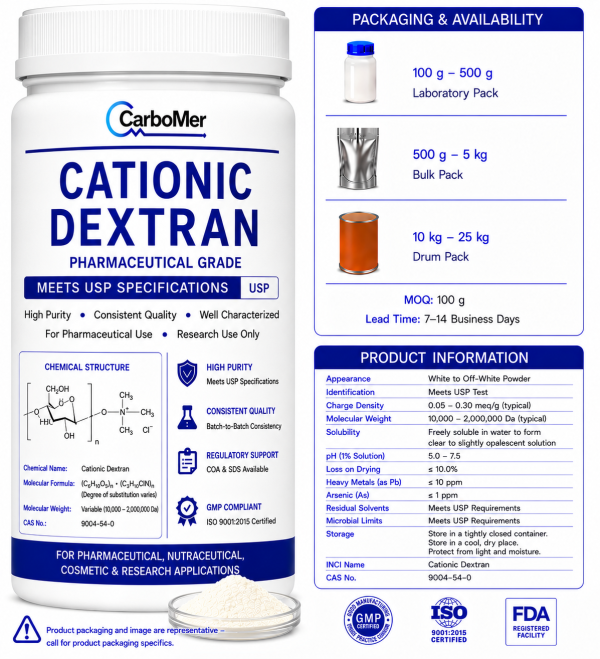

Cationic dextran
$78.30
- Description
- Additional information
Description
Cationic Dextran
Cationic Dextran is a positively charged derivative of Dextran used in pharmaceutical research, drug-delivery development, biotechnology, biomaterials, analytical studies, and specialty formulation programs where ionic interaction, complex formation, mucoadhesion, and controlled polymer performance are important. The term Cationic Dextran can refer to several chemically modified Dextran systems, including Diethylaminoethyl Dextran and quaternary ammonium-substituted Dextran derivatives, so the exact cationic functionality, molecular weight, degree of substitution, and counterion should be confirmed for the individual grade.
• Positively charged derivative of Dextran
• May include Diethylaminoethyl or quaternary Ammonium functionality depending on grade
• Suitable for pharmaceutical research, nucleic-acid delivery, biomaterials, analytical, and specialty formulation programs
• Cationic functionality supports ionic interaction with negatively charged molecules and surfaces
• Functional performance depends on molecular weight, charge density, degree of substitution, pH, and ionic strength
• Supported by technical documentation for supplier qualification and polymer characterization
Cationic Dextran is produced through chemical modification of the Hydroxyl-rich Dextran backbone to introduce positively charged or protonatable functional groups. Dextran itself is a glucose-based polysaccharide, while cationic modification changes its electrostatic behavior and expands its usefulness in systems involving negatively charged proteins, nucleic acids, membranes, particles, or other polymers.
One established type of Cationic Dextran is Diethylaminoethyl Dextran, commonly abbreviated DEAE-Dextran. This derivative contains amino-functional groups that provide cationic character under appropriate solution conditions. Other Cationic Dextran materials incorporate permanently charged quaternary ammonium groups. These derivatives should not be treated as interchangeable because charge mechanism, degree of substitution, counterion, molecular weight, and polymer architecture can substantially influence solubility, binding, viscosity, biological interaction, and formulation performance.
Cationic Dextran may be evaluated in nucleic-acid delivery research, nanoparticle and polyplex development, controlled-release systems, mucoadhesive materials, protein interaction studies, enzyme stabilization, hydrogels, coatings, and other pharmaceutical or biomedical research programs. Positively charged Dextran derivatives can form ionic complexes with negatively charged biomolecules such as DNA and RNA, making them relevant to gene-delivery and transfection research. Cationic modification can also support interaction with negatively charged biological surfaces and polymers.
For companies looking to buy Cationic Dextran, supplier qualification should extend beyond the general polymer name. A qualified Cationic Dextran supplier should provide clear information regarding the parent Dextran molecular weight, cationic substituent identity, degree of substitution, charge density, counterion, molecular-weight distribution where available, appearance, moisture content, residual reagents, residual solvents, ash, nitrogen content where relevant, solubility, viscosity, and recommended storage conditions. The exact derivative should be specified before purchase.
CarboMer approaches Cationic Dextran sourcing with a regulation-first and manufacturing-centered perspective. Research and development teams benefit from a supplier capable of supporting polymer characterization, charge-density evaluation, complexation studies, nanoparticle development, formulation screening, and scale-up planning. Quality professionals require traceable batch documentation and clearly defined substitution characteristics. Procurement teams need confidence that the molecular and ionic properties established during qualification can be maintained across repeat purchases.
When customers purchase Cationic Dextran for pharmaceutical or biomedical development, material performance should be evaluated under the actual formulation conditions. Ionic strength, pH, polymer concentration, molecular weight, degree of substitution, charge ratio, and the characteristics of interacting molecules can influence aggregation, complex stability, viscosity, particle formation, and biological performance. A Cationic Dextran grade optimized for one application may not provide equivalent behavior in another system.
The material is supported by standard technical documentation, including a Certificate of Analysis, Safety Data Sheet, and related product information where applicable. Available characterization may include polymer identity, average molecular weight, degree of substitution, nitrogen or charge-related measurements, moisture content, residual reagents, residual solvents, viscosity, solubility, storage conditions, and retest information. Exact acceptance criteria should be confirmed for the individual grade before ordering.
Cationic Dextran should be handled using laboratory or manufacturing controls appropriate to the selected derivative and intended application. Powder handling should minimize contamination, uncontrolled moisture exposure, and airborne particulate generation. When preparing aqueous solutions or complexes, pH, ionic strength, temperature, polymer concentration, order of addition, and mixing conditions should be controlled because these parameters can significantly influence cationic polymer behavior.
The material is packaged in appropriate containers selected to protect product quality from moisture, contamination, and environmental exposure during storage and transportation. Packaging formats, molecular-weight and substitution options where available, minimum order quantities, availability, and lead times may be discussed according to analytical, pharmaceutical research, biotechnology, formulation-development, and qualified manufacturing requirements.
As with all CarboMer products, customers receive responsive technical communication and documentation support intended to advance material qualification, polymer characterization, formulation development, scale-up, and long-term supply planning.
Additional information
| Dimensions | 1 × 1 × 1 cm |
|---|