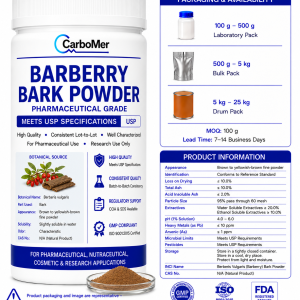
Barberry Bark powder
- Description
- Additional information
Description
Barberry Bark Powder
Barberry bark powder is a botanical raw material derived from the bark of plants within the Berberis genus and used in nutraceutical, botanical research, herbal formulation, analytical, and specialty product-development programs. Because “Barberry bark” may refer to bark from different Berberis species or plant parts, botanical identity, source material, alkaloid profile, and manufacturing specifications should be confirmed before purchase or formulation use.
• Botanical powder derived from Berberis bark
• Suitable for nutraceutical, herbal, analytical, and botanical research applications
• Naturally contains Isoquinoline alkaloids, including berberine in applicable Berberis species
• Requires verification of botanical species, plant part, origin, particle size, and phytochemical profile
• Quality evaluation may include microbial, pesticide, elemental impurity, and residual processing controls
• Supported by technical documentation for supplier qualification and botanical traceability
Barberry refers to plants within the Berberis genus, including Berberis vulgaris, a species with an established history of botanical use. Scientific literature identifies Berberis vulgaris as containing a range of phytochemicals, including alkaloids, phenolic compounds, tannins, sterols, and triterpenes. Berberine is one of the best-known Isoquinoline alkaloids associated with barberry and other Berberis species.
Barberry bark powder may be evaluated for botanical supplements, herbal blends, encapsulated products, powdered preparations, extraction programs, analytical studies, and phytochemical research. The composition of a botanical powder can vary according to species, plant part, geographic origin, harvest conditions, processing method, particle size, and storage history. For this reason, the common name alone should not be used to establish material equivalence.
For companies looking to buy Barberry bark powder, supplier qualification should begin with confirmed botanical identity. A qualified Barberry bark powder supplier should provide the Latin binomial, plant part, country or region of origin, processing method, appearance, particle-size information, moisture content, and applicable phytochemical specifications. Where berberine content is relevant to the intended application, the test method and acceptance criteria should also be defined. PubChem confirms that berberine occurs naturally in botanical materials including barberry, but the concentration present in a specific bark powder must be established through lot-specific testing rather than assumed from the botanical name.
CarboMer approaches Barberry bark powder sourcing with a regulation-first and manufacturing-centered perspective. Research and formulation teams benefit from a supplier capable of supporting botanical identity review, raw-material characterization, extraction studies, and formulation evaluation. Quality teams require traceable batch documentation, verified source information, and clearly defined acceptance criteria. Procurement professionals need confidence that the botanical material qualified during development can be sourced consistently as purchasing requirements increase.
When customers purchase Barberry bark powder for nutraceutical or food-related applications, additional quality controls may be appropriate. Depending on the intended use and destination market, evaluation may include total aerobic microbial count, yeast and mold, specified pathogens, pesticide residues, elemental impurities, mycotoxins, foreign matter, moisture, ash, and botanical adulteration testing. These requirements should be defined according to the finished-product category, internal quality program, and applicable regulatory standards.
Regulatory suitability should be reviewed independently for each intended application. Botanical materials and preparations may be subject to different requirements depending on whether they are used in dietary supplements, foods, traditional herbal medicines, cosmetics, or research products. The European Medicines Agency notes that herbal substances and preparations are evaluated through dedicated regulatory frameworks and scientific assessments rather than being assumed equivalent solely from traditional use.
The material is supported by standard technical documentation, including a Certificate of Analysis, Safety Data Sheet where applicable, botanical identity information, and related product documentation. Available testing may include appearance, identity, particle size, moisture, ash, phytochemical markers, microbial limits, pesticide residues, elemental impurities, and storage requirements. Exact acceptance criteria should be confirmed for the individual Barberry Bark Powder grade before ordering.
Barberry bark powder should be handled using appropriate botanical raw-material controls. Personnel should follow site-specific procedures for receiving, sampling, weighing, blending, extraction, storage, and disposal. Powder handling should minimize airborne particulate generation, cross-contamination, moisture exposure, and unnecessary contact with environmental contaminants.
The material is packaged in suitable containers selected to protect botanical quality from moisture, contamination, light, and environmental exposure during storage and transportation. Packaging formats, particle-size options, minimum order quantities, availability, and lead times may be discussed according to research, nutraceutical, formulation-development, and commercial purchasing requirements.
As with all CarboMer products, customers receive responsive technical communication and documentation support intended to advance botanical qualification, formulation development, analytical evaluation, scale-up, and long-term supply planning.
Additional information
| Weight | 2500 g |
|---|