b-Cyclodextrin
$99.30
- Description
- Additional information
Description
-Cyclodextrin
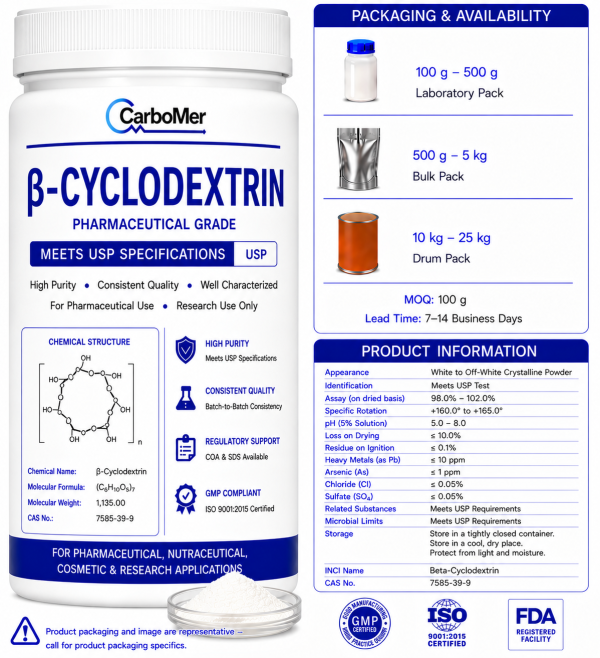
-Cyclodextrin USP is a cyclic oligosaccharide composed of seven Glucose units joined through α-(1→4) glycosidic bonds. It is used in pharmaceutical, nutraceutical, food, cosmetic, analytical, and specialty formulation programs where inclusion complex formation, solubility enhancement, stabilization, odor or taste masking, and controlled interaction with hydrophobic compounds are important.
• Cyclic oligosaccharide containing seven glucose units
• Hydrophilic exterior with a relatively hydrophobic internal cavity
• Suitable for inclusion-complex formation with compatible guest molecules
• Used in pharmaceutical formulation, nutraceutical, food, cosmetic, analytical, and research applications
• Can support solubility, dissolution, stability, and sensory-property modification
• Supported by technical documentation for supplier qualification and material characterization
-Cyclodextrin USP belongs to the family of naturally derived Cyclodextrins produced through enzymatic conversion of starch. Its ring-shaped molecular structure creates an outer surface rich in hydroxyl groups and an internal cavity that is comparatively hydrophobic. This arrangement allows -Cyclodextrin USP to form noncovalent inclusion complexes with suitably sized molecules or molecular regions, particularly compounds with limited water solubility or hydrophobic functionality.
The seven-membered glucose ring gives -Cyclodextrin USP a cavity size that is useful for interaction with a broad range of organic compounds. Inclusion-complex formation can alter the apparent physicochemical behavior of a guest compound without creating a new covalent molecule. Depending on the formulation, this interaction may improve apparent aqueous solubility, dissolution rate, physical stability, chemical stability, volatility control, or sensory characteristics.
In pharmaceutical development, -Cyclodextrin USP may be evaluated as a complexing excipient in oral solid dosage forms, oral liquids, topical systems, and other formulation platforms. Cyclodextrins are commonly investigated when a drug candidate has limited aqueous solubility, requires stabilization against environmental degradation, or benefits from modification of dissolution characteristics. -Cyclodextrin USP can also function as a formulation aid in tablet systems, including certain applications involving binding, filling, disintegration, and direct compression.
The suitability of -Cyclodextrin USP depends on the characteristics of the guest molecule and the intended dosage form. Molecular size, shape, polarity, ionization state, formulation pH, temperature, solvent composition, concentration, and competing formulation components can all influence inclusion-complex formation. Formulation teams should establish the appropriate Cyclodextrin-to-guest ratio experimentally rather than assuming that all hydrophobic molecules will form equivalent complexes.
Beyond pharmaceuticals, -Cyclodextrin USP may be used in food, nutraceutical, cosmetic, and specialty applications where encapsulation or molecular inclusion can help manage flavors, fragrances, oils, vitamins, botanical constituents, or other lipophilic materials. It may also be used in analytical chemistry, separation science, materials research, and host-guest chemistry.
For companies looking to buy -Cyclodextrin USP, supplier qualification should consider more than nominal chemical identity. A qualified -Cyclodextrin USP supplier should provide information regarding identity, assay or purity, water content, reducing substances or related carbohydrate impurities where applicable, residual processing materials, elemental impurities, microbial quality, particle characteristics, solution properties, and recommended storage conditions. The exact specification should be matched to the intended pharmaceutical, food, research, or specialty application.
CarboMer approaches -Cyclodextrin USP sourcing with a regulation-first and manufacturing-centered perspective. Research and development teams benefit from a supplier capable of supporting inclusion-complex evaluation, solubility studies, formulation screening, analytical development, and scale-up planning. Quality professionals require traceable batch documentation and clearly defined acceptance criteria. Procurement teams need confidence that the material characteristics established during qualification can be maintained across repeat purchases and larger production requirements.
When customers purchase -Cyclodextrin USP for pharmaceutical development, the intended dosage form and route of administration should be reviewed during qualification. Unmodified -Cyclodextrin USP and chemically modified Cyclodextrins such as Hydroxypropyl--Cyclodextrin USP or Sulfobutylether--Cyclodextrin USP have different physicochemical and application characteristics and should not be treated as interchangeable. The appropriate Cyclodextrin should be selected according to solubility requirements, formulation performance, safety considerations, route of administration, and regulatory strategy.
The material is supported by standard technical documentation, including a Certificate of Analysis, Safety Data Sheet, and related product information where applicable. Available characterization may include identity, assay, water content, impurity controls, particle characteristics, microbial limits, elemental impurity information, storage conditions, and retest information. Exact acceptance criteria should be confirmed for the individual grade before ordering.
-Cyclodextrin USP should be handled using laboratory or manufacturing controls appropriate to the selected grade and intended application. Powder should be protected from contamination and unnecessary moisture exposure. During inclusion-complex or solution preparation, temperature, pH, concentration, mixing time, solvent composition, and order of addition should be controlled because these parameters can affect complex formation and formulation reproducibility.
The material is packaged in appropriate containers selected to protect product quality from moisture, contamination, and environmental exposure during storage and transportation. Packaging formats, minimum order quantities, availability, and lead times may be discussed according to pharmaceutical, nutraceutical, food, cosmetic, analytical, research, and commercial manufacturing requirements.
As with all CarboMer products, customers receive responsive technical communication and documentation support intended to advance material qualification, inclusion-complex development, formulation optimization, analytical evaluation, scale-up, and long-term supply planning.
Additional information
| Weight | 8.52 g |
|---|---|
| Dimensions | 1 × 1 × 1 cm |