Alginate sodium salt
$0.00
- Description
- Additional information
Description
Alginate Sodium Salt
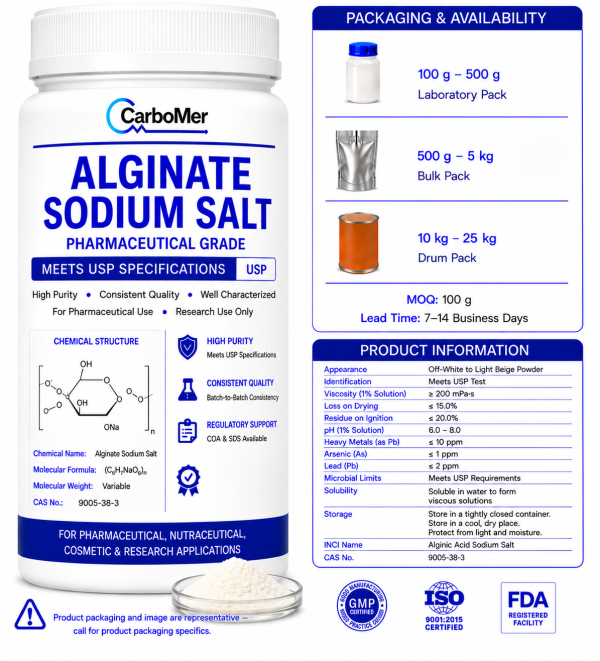
Alginate Sodium salt, commonly known as Sodium Alginate, is the Sodium salt of Alginic acid, a naturally derived polysaccharide obtained primarily from brown algae. It is used in pharmaceutical, food, nutraceutical, biomedical, cosmetic, and specialty formulation programs where thickening, gel formation, stabilization, viscosity control, and controlled material performance are important.
• Naturally derived polysaccharide salt sourced primarily from brown algae
• Commonly used as a thickener, stabilizer, gelling agent, binder, and viscosity modifier
• Suitable for pharmaceutical, food, nutraceutical, biomedical, and specialty formulation applications
• Forms ionically crosslinked gels in the presence of suitable multivalent cations such as calcium
• Polymer performance depends on molecular weight, viscosity grade, and mannuronic-to-guluronic acid composition
• Supported by technical documentation for supplier qualification and material characterization
Alginate Sodium salt is composed of Sodium salts of Alginic acid, a linear polysaccharide containing blocks of mannuronic acid and guluronic acid residues. The relative proportion and distribution of these Uronic acid units can influence viscosity, gel strength, elasticity, and other functional characteristics. Because Sodium Alginate is a polymeric material rather than a single discrete low-molecular-weight compound, grades are commonly differentiated according to viscosity, molecular weight, particle size, source, and functional performance.
Alginate Sodium salt is widely used in pharmaceutical formulation as an excipient. It may function as a binder, disintegrant, matrix-forming polymer, viscosity modifier, stabilizer, and modified-release excipient depending on the dosage form and formulation design. It is also evaluated in hydrogels, beads, microencapsulation systems, wound-related biomaterials, and other drug-delivery platforms because of its ability to form gels under relatively mild processing conditions.
The polymer is particularly useful in systems involving ionic gelation. Guluronic-acid-rich regions of Alginate can interact with divalent cations such as calcium to create crosslinked gel networks. This behavior is frequently used in encapsulation, hydrogel formation, controlled-release research, food structuring, biomedical materials, and specialty formulation development. Performance can vary substantially with Alginate concentration, grade, calcium concentration, pH, ionic strength, shear, hydration conditions, and processing sequence.
In food and nutritional applications, Alginate Sodium salt may be used for thickening, stabilization, emulsification, textural control, suspension support, and related technical functions. The selected grade should be matched to the intended product category, processing conditions, internal quality requirements, and destination-market regulations.
For companies looking to buy Alginate Sodium salt, supplier qualification should extend beyond the general polymer name. A qualified Alginate Sodium salt supplier should provide clear information regarding botanical or marine source, viscosity grade, molecular-weight characteristics, mannuronic-to-guluronic acid composition where relevant, particle size, moisture content, ash, pH, microbial quality, elemental impurities, residual processing materials, and solubility or dispersion characteristics. Different Sodium Alginate grades can perform differently even when they share the same general chemical identity.
CarboMer approaches Alginate Sodium salt sourcing with a regulation-first and manufacturing-centered perspective. Research and development teams benefit from a supplier capable of supporting viscosity selection, hydration studies, gelation evaluation, formulation screening, and scale-up planning. Quality professionals require traceable batch documentation and clearly defined acceptance criteria. Procurement teams need confidence that the functional properties established during qualification can be maintained across repeat purchases and larger commercial requirements.
When customers purchase Alginate Sodium salt for pharmaceutical development, the intended dosage form and route of administration should be considered during qualification. Grade-specific manufacturing controls, purity, microbiological specifications, elemental impurities, viscosity, and functional characteristics should be reviewed against the proposed application. Research-grade, food-grade, pharmaceutical-development, and other specialty grades should not be treated as interchangeable without appropriate qualification.
The material is supported by standard technical documentation, including a Certificate of Analysis, Safety Data Sheet, and related product information where applicable. Available characterization may include identity, viscosity, moisture, pH, ash, particle size, molecular-weight information, microbiological limits, elemental impurities, storage conditions, and retest information. Exact acceptance criteria should be confirmed for the individual grade before ordering.
Alginate Sodium salt should be handled using laboratory or manufacturing controls appropriate to the selected grade and application. Powder should be protected from contamination and uncontrolled moisture exposure. During aqueous processing, controlled addition and sufficient hydration time can help prevent agglomeration and support reproducible viscosity. Mixing rate, temperature, polymer concentration, pH, and ionic composition should be controlled because these factors can influence solution and gel behavior.
The material is packaged in appropriate containers selected to protect product quality from moisture, contamination, and environmental exposure during storage and transportation. Packaging formats, viscosity grades, minimum order quantities, availability, and lead times may be discussed according to pharmaceutical, food, nutraceutical, biomedical, research, and commercial manufacturing requirements.
As with all CarboMer products, customers receive responsive technical communication and documentation support intended to advance material qualification, polymer characterization, formulation development, scale-up, and long-term supply planning.
Additional information
| Weight | 50 g |
|---|---|
| Dimensions | 1 × 1 × 1 cm |