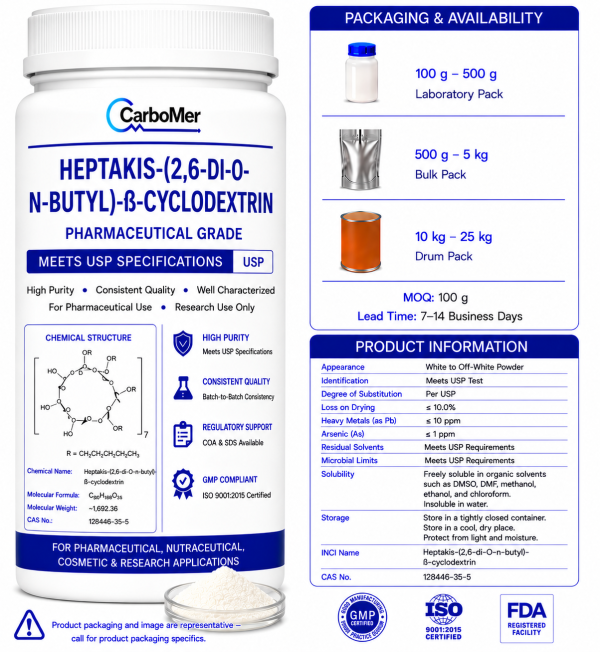
Heptakis-(2,6-di-O-n-butyl)-ß-cyclodextrin
$1,093.40
- Description
- Additional information
Description
Heptakis-(2,6-di-O-n-butyl)-ß-cyclodextrin
Heptakis-(2,6-di-O-n-butyl)-ß-cyclodextrin is a selectively alkylated ß-Cyclodextrin derivative used in specialty pharmaceutical research, supramolecular chemistry, analytical development, materials science, and formulation studies where modified host-guest interactions, increased hydrophobicity, and controlled cyclodextrin functionality are important. The material is produced by substitution of the hydroxyl groups at the 2- and 6-positions of the seven glucose units within the ß-Cyclodextrin structure with n-butyl groups.
• Selectively alkylated derivative of ß-Cyclodextrin
• Contains seven glucose units with n-butyl substitution at the 2- and 6-positions
• Increased hydrophobic character compared with unmodified ß-Cyclodextrin
• Suitable for inclusion-complex studies, supramolecular research, analytical applications, and specialty formulation development
• Functional behavior depends on substitution pattern, purity, molecular characteristics, and processing conditions
• Supported by technical documentation for supplier qualification and material characterization
Heptakis-(2,6-di-O-n-butyl)-ß-cyclodextrin is based on the cyclic structure of ß-Cyclodextrin, which contains seven glucose units arranged to form a molecular cavity capable of interacting with suitably sized guest molecules. Selective replacement of hydroxyl hydrogens at the 2- and 6-positions with n-butyl groups significantly alters the polarity and hydrophobic character of the parent cyclodextrin. The hydroxyl groups at the 3-position remain available unless further derivatization is performed.
This controlled substitution pattern distinguishes Heptakis-(2,6-di-O-n-butyl)-ß-cyclodextrin from randomly substituted butylated cyclodextrins and fully alkylated derivatives. The defined positioning of the n-butyl groups can influence cavity environment, guest-molecule affinity, organic-solvent compatibility, intermolecular interactions, and material behavior. For this reason, the substitution pattern should be confirmed as part of product qualification rather than relying solely on a general description such as butylated ß-Cyclodextrin.
Heptakis-(2,6-di-O-n-butyl)-ß-cyclodextrin may be evaluated in host-guest chemistry, inclusion-complex research, molecular recognition studies, analytical separations, specialty drug-delivery research, adhesives, polymer systems, and advanced materials development. Alkylated cyclodextrins have also been investigated where enhanced compatibility with hydrophobic compounds or nonaqueous environments is desired. The actual performance of this derivative depends on the guest molecule, solvent system, concentration, temperature, processing method, and other application-specific conditions.
For companies looking to buy Heptakis-(2,6-di-O-n-butyl)-ß-cyclodextrin, supplier qualification should extend beyond general cyclodextrin identity. A qualified Heptakis-(2,6-di-O-n-butyl)-ß-cyclodextrin supplier should provide clear information regarding starting ß-Cyclodextrin identity, substitution pattern, degree of substitution, assay or purity, residual unmodified cyclodextrin, partially substituted derivatives, residual solvents, water content, appearance, and storage requirements. Analytical confirmation of selective 2,6-di-O-n-butyl substitution may also be important for research and development programs requiring consistent molecular architecture.
CarboMer approaches Heptakis-(2,6-di-O-n-butyl)-ß-cyclodextrin sourcing with a regulation-first and manufacturing-centered perspective. Research and development teams benefit from a supplier capable of supporting material characterization, inclusion-complex evaluation, molecular-recognition studies, analytical development, and scale-up planning. Quality teams require traceable batch documentation and clearly defined substitution and purity specifications. Procurement professionals need confidence that the material characteristics established during qualification can be maintained across subsequent purchases.
When customers purchase Heptakis-(2,6-di-O-n-butyl)-ß-cyclodextrin for pharmaceutical or biomedical research, the regulatory status of the derivative should be evaluated independently from that of unmodified ß-Cyclodextrin. Modification of the cyclodextrin structure can substantially alter its physicochemical, biological, and toxicological characteristics. Research use does not automatically establish suitability for human administration, a particular dosage form, or a specific route of delivery. Manufacturing controls, impurity profiles, toxicological information, and application-specific regulatory requirements should be reviewed for the individual grade.
The material is supported by standard technical documentation, including a Certificate of Analysis, Safety Data Sheet, and related product information where applicable. Available characterization may include chemical identity, substitution pattern, degree of substitution, assay or purity, residual solvents, water content, chromatographic profile, spectroscopic characterization, storage conditions, and retest information. Exact acceptance criteria should be confirmed for the individual grade before ordering.
Heptakis-(2,6-di-O-n-butyl)-ß-cyclodextrin should be handled by trained personnel using laboratory or manufacturing controls appropriate to the selected grade and application. Personnel should review the current Safety Data Sheet and follow site-specific procedures for receiving, sampling, weighing, dissolving, transferring, processing, storage, and disposal. Protection from contamination, moisture, excessive heat, and other environmental conditions that could affect material quality should be incorporated into handling procedures.
The material is packaged in appropriate containers selected to protect product integrity during storage, handling, and transportation. Packaging formats, minimum order quantities, availability, and lead times may be discussed according to analytical, pharmaceutical research, materials-development, and qualified manufacturing requirements.
As with all CarboMer products, customers receive responsive technical communication and documentation support intended to advance material qualification, cyclodextrin characterization, formulation development, analytical evaluation, scale-up, and long-term supply planning.
Additional information
| Weight | 0.1 g |
|---|---|
| Dimensions | 1 × 1 × 1 cm |