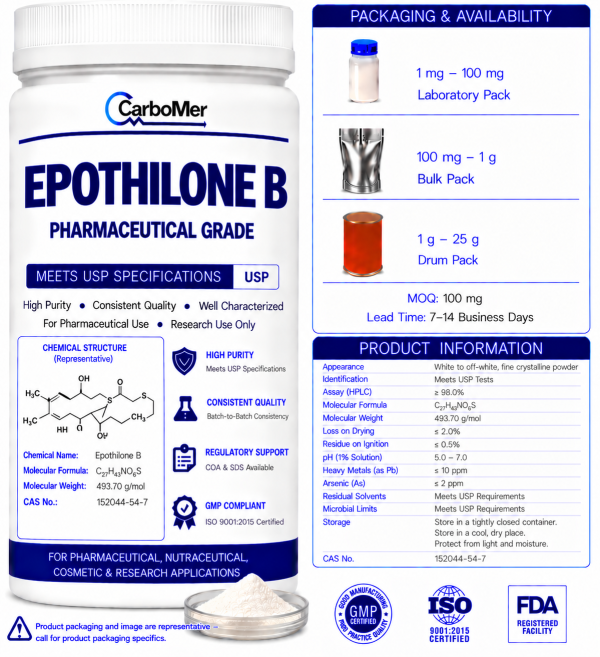
Epothilone B
$442.70
- Description
- Additional information
Description
Epothilone B | Microtubule-Stabilizing Research Compound
Epothilone B, also known as Patupilone, is a macrocyclic natural product studied for its microtubule-stabilizing activity. Originally isolated from the myxobacterium Sorangium Cellulosum, it binds to tubulin and promotes microtubule stabilization, disrupting the microtubule dynamics required for normal cell division. These properties make Epothilone B relevant to cancer biology, cytoskeletal research, and preclinical drug development.
For organizations sourcing Epothilone B for research, chemical identity, purity, biological activity, and handling requirements are important selection criteria. Contact CarboMer to discuss availability, product specifications, and documentation for your intended application.
Epothilone B Applications
Cancer Biology and Antiproliferative Research
Epothilone B is used in experimental studies investigating mitotic arrest, cell proliferation, and cell death. Researchers evaluate its effects in appropriate cellular and preclinical models to explore responses to microtubule-stabilizing compounds.
Experimental findings depend on the model, exposure conditions, and study design. Activity observed in laboratory systems does not establish clinical safety or efficacy.
Microtubule and Cytoskeletal Studies
As a microtubule-stabilizing agent, Epothilone B supports investigations of tubulin polymerization, spindle function, and cytoskeletal dynamics. It may be used alongside other characterized compounds to compare mechanisms and cellular responses.
Epothilone B stabilizes microtubules rather than acting as a microtubule-depolymerizing agent, an important distinction when selecting compounds for mechanistic studies.
Drug Resistance Research
Epothilone B has been investigated in models of resistance to other microtubule-targeting agents, including taxanes. Such studies can help researchers examine how drug transport, tubulin characteristics, and other cellular factors influence treatment response.
Sensitivity varies across experimental systems, so resistance-related findings should not be generalized to every model.
Preclinical Formulation and Analytical Development
Epothilone B may be evaluated in solubility, stability, delivery-system, and analytical-method development studies. Solvent selection, formulation compatibility, and sample preparation should follow product-specific data and validated experimental procedures.
Research material is not automatically suitable for clinical formulation or human administration.
Technical Considerations for Sourcing Epothilone B
When evaluating an Epothilone B supplier, review the following:
• Chemical identity: Confirm that the material is Epothilone B, not Epothilone A, ixabepilone, or another related compound.
• Purity and assay: Review analytical methods, acceptance limits, and whether reported purity represents chromatographic purity or an assigned content value.
• Impurity profile: Evaluate related compounds, degradation products, and residual solvents where relevant.
• Biological characterization: Determine whether activity data are available and appropriate to your research.
• Solubility and preparation: Confirm recommended solvents, stock preparation procedures, and compatibility with the intended assay.
• Storage and stability: Follow documented temperature, light-protection, and solution-storage requirements.
• Safety and handling: Treat Epothilone B as a potent, potentially hazardous research compound and follow the safety data sheet and institutional procedures.
• Supporting documentation: Request available specifications, a certificate of analysis, and a safety data sheet.
Source Epothilone B from CarboMer
Looking for Epothilone B for cancer research, tubulin studies, or preclinical development? Contact CarboMer with your intended application, required quantity, purity criteria, and documentation needs to discuss availability and request a quotation.
Confirm the material’s intended-use designation before ordering. A research-use product must not be assumed suitable for diagnostic, therapeutic, or human use.
Frequently Asked Questions
What is Epothilone B?
Epothilone B is a macrocyclic compound in the epothilone family. Also called Patupilone, it is studied for its ability to stabilize microtubules and interfere with cell division.
How does Epothilone B work?
Epothilone B binds to tubulin and stabilizes microtubules, suppressing the dynamic changes needed for normal mitotic spindle function. This can lead to mitotic arrest and subsequent cell death in susceptible experimental systems.
Is Epothilone B the same as Patupilone?
Yes. Patupilone is another name for Epothilone B.
Is Epothilone B the same as Ixabepilone?
No. Ixabepilone is a semisynthetic epothilone analog. It is a distinct compound and should not be substituted for Epothilone B without application-specific evaluation.
Can Epothilone B be used as an analytical reference standard?
Not automatically. Reference-standard use requires appropriate characterization and documentation, including an assigned content value when needed for quantitative analysis.
Is research-grade Epothilone B suitable for human use?
A research-grade designation does not establish suitability for human administration. It should be used only within its documented intended use and applicable institutional requirements.
Additional information
| Dimensions | 1 × 1 × 1 cm |
|---|