Xyloglucan
$409.40
- Description
- Additional information
Description
Xyloglucan
Xyloglucan is a naturally derived, hydrophilic polysaccharide used in pharmaceutical, food, biomedical, and specialty formulation programs where viscosity modification, mucoadhesion, film formation, gel behavior, and controlled material performance are important. Tamarind seed is a well-established commercial source of Xyloglucan, with Tamarind seed polysaccharide characterized as a Galactoxyloglucan composed primarily of glucose, xylose, and galactose residues.
• Naturally derived polysaccharide for pharmaceutical, food, biomedical, and formulation applications
• Commonly sourced from Tamarindus indica seed kernels
• Hydrophilic polymer with viscosity-modifying and mucoadhesive properties
• Suitable for hydrogel, controlled-release, film-forming, and specialty delivery-system research
• Material performance can depend on molecular weight, substitution pattern, purity, and processing history
• Supported by technical documentation for supplier qualification and material characterization
Xyloglucan is a plant-derived polysaccharide containing a β-(1→4)-linked Glucan backbone with Xylose-containing side chains and variable galactose substitution. Tamarind seed Xyloglucan is a natural neutral hemicellulose with strong affinity for water and the ability to form intermolecular and intramolecular associations in aqueous systems. These structural characteristics contribute to its usefulness as a functional polymer in formulation, food, and biomedical research.
The material may be evaluated as a thickening agent, stabilizing polymer, film-forming material, mucoadhesive excipient, matrix-forming polymer, or component of controlled drug-delivery systems. Research has investigated Xyloglucan in oral, ocular, nasal, topical, and other delivery platforms, particularly where increased residence time, controlled release, or in situ gel formation may provide formulation benefits. Modified or partially degraded Xyloglucan can also exhibit thermo-responsive gel behavior, making polymer grade and processing history important considerations during development.
In pharmaceutical formulation research, Xyloglucan has been investigated for hydrophilic matrices, sustained-release systems, in situ gels, and mucoadhesive delivery approaches. Its polymer concentration can influence viscosity, gel strength, diffusion, drug-release behavior, and processing performance. Development teams should therefore evaluate molecular weight, viscosity profile, hydration rate, polymer concentration, solution pH, temperature response, compatibility with active ingredients and excipients, and stability under the intended processing conditions.
For organizations looking to buy Xyloglucan, supplier qualification should extend beyond confirming the polymer name. A qualified Xyloglucan supplier should provide information regarding botanical or manufacturing source, molecular-weight characteristics, viscosity, monosaccharide composition, moisture content, ash, protein residues, microbial quality, residual processing materials, appearance, solubility or dispersibility, and storage requirements. Because Xyloglucan structure may vary according to plant source and processing method, the exact grade should be evaluated against the intended formulation before purchase.
CarboMer approaches Xyloglucan sourcing with a regulation-first and manufacturing-centered perspective. Research and development teams benefit from a supplier capable of supporting polymer characterization, hydration studies, rheological evaluation, formulation screening, and scale-up planning. Quality teams require traceable batch documentation and clearly defined material specifications. Procurement professionals need confidence that the polymer characteristics established during development can be maintained across repeat purchases and larger commercial requirements.
Xyloglucan and tamarind seed polysaccharide also have established food-related applications. Codex General Standard for Food Additives information includes tamarind seed polysaccharide as a food additive permitted in designated applications under good manufacturing practice conditions. However, regulatory suitability must be evaluated according to the specific Xyloglucan grade, source, intended application, use level, destination market, and product category.
When customers purchase Xyloglucan for pharmaceutical or biomedical development, research use should not be interpreted as automatic qualification for a particular route of administration. Suitability for oral, ophthalmic, nasal, injectable, implantable, or other applications depends on manufacturing controls, purity, microbial and endotoxin requirements, toxicological information, and the regulatory framework applicable to the finished product.
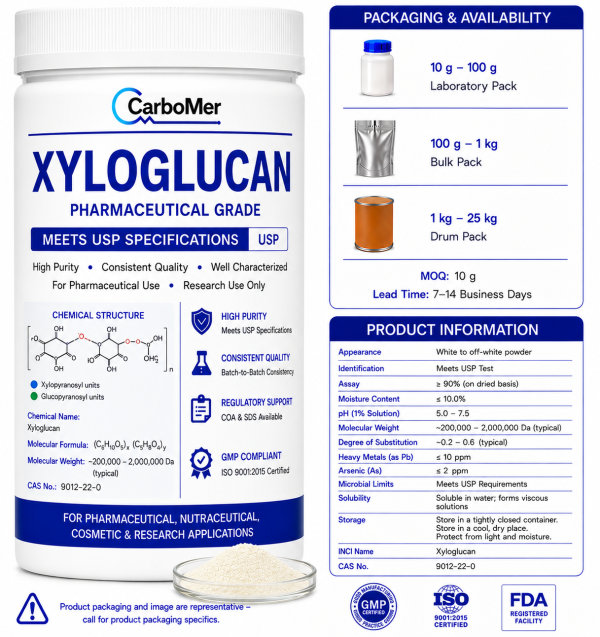
The material is supported by standard technical documentation, including a Certificate of Analysis, Safety Data Sheet, and related product information where applicable. Available characterization may include identity, viscosity, molecular-weight information, moisture, ash, microbial limits, source information, solubility, storage requirements, and retest data. Exact specifications should be confirmed for the individual grade before ordering.
Xyloglucan should be handled using laboratory or manufacturing controls appropriate to the selected grade and application. Powder handling procedures should minimize contamination and uncontrolled moisture exposure. When preparing aqueous dispersions or gels, controlled addition, mixing, hydration time, temperature, and polymer concentration should be considered to achieve reproducible performance.
The material is packaged in appropriate containers selected to protect product quality from moisture, contamination, and environmental exposure during storage and transportation. Packaging formats, minimum order quantities, availability, and lead times may be discussed according to analytical, food, formulation-development, research, and qualified manufacturing requirements.
As with all CarboMer products, customers receive responsive technical communication and documentation support intended to advance material qualification, polymer characterization, formulation development, scale-up, and long-term supply planning.
Additional information
| Weight | 0.1 g |
|---|---|
| Dimensions | 1 × 1 × 1 cm |